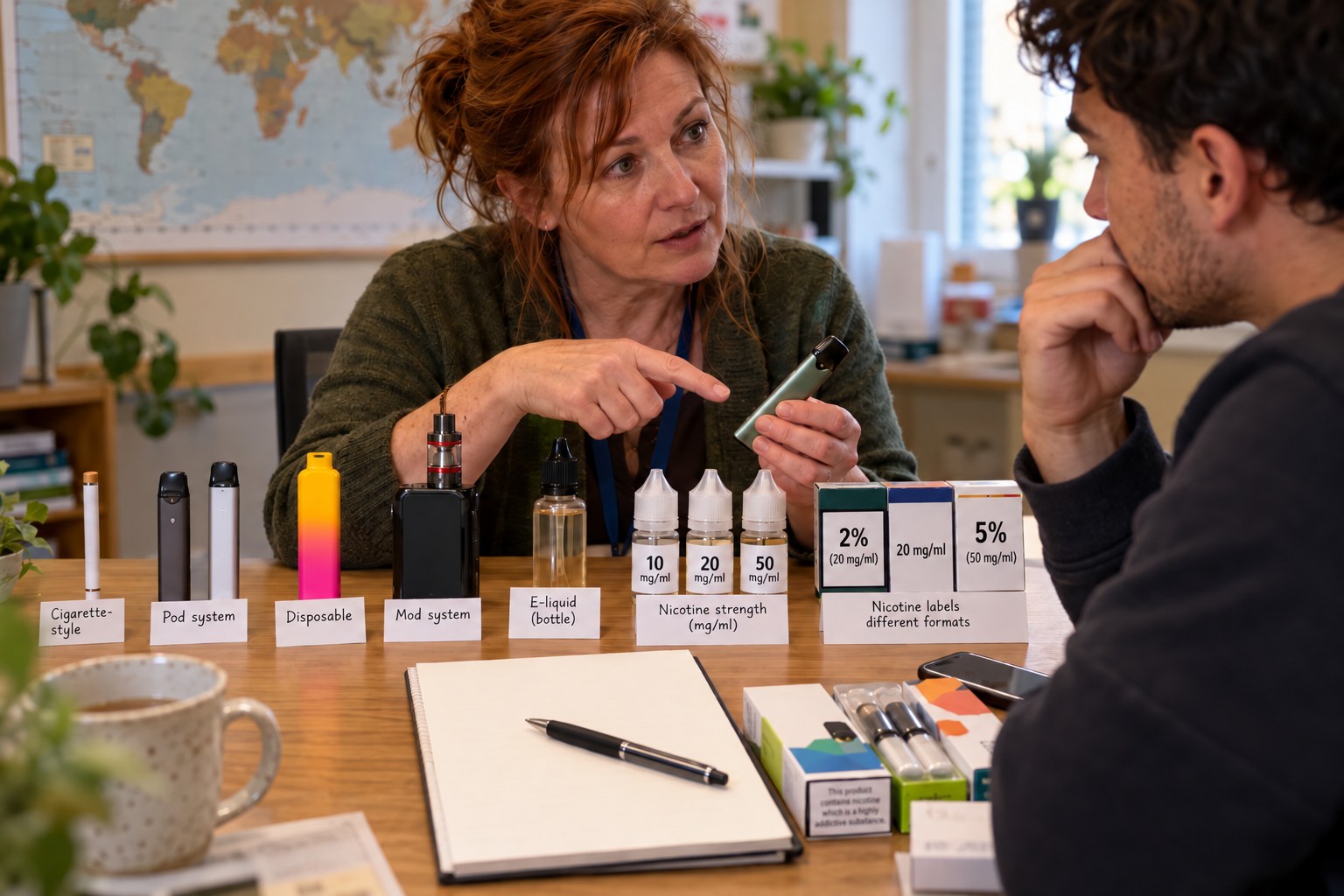
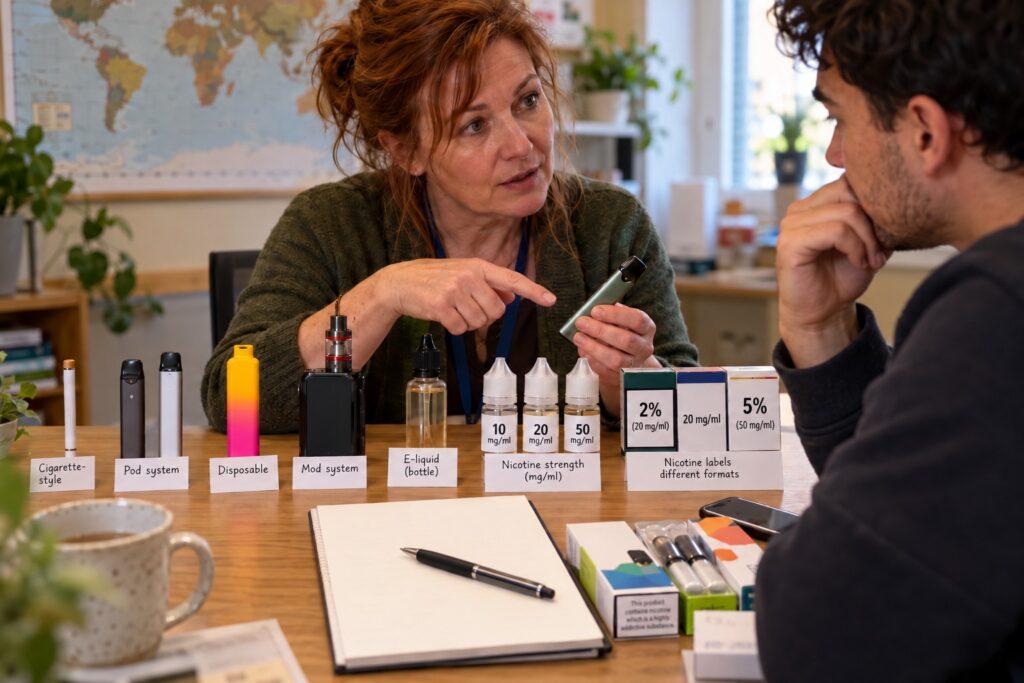
It is one of the most useful sentences you can hear in a vaping assessment, because it tells you two things at once. The client has looked at the label. And the label has not told them what they think it has.
With cigarettes, the first questions are easy: how many a day, since when. With vaping, the answers to “how much” and “how strong” are hidden in a device type, a bottle size and a label written in units most people cannot read. This article is about getting those answers anyway, and about what they are for in vaping cessation work.
Device, bottle, label: three questions before any number.
Three Kinds of Vape
The CDC describes three main types of e-cigarette (Centers for Disease Control and Prevention [CDC], 2024):
Disposable — pre-filled and sometimes rechargeable, but not designed to be refilled.
Pre-filled pods or cartridges — a rechargeable device with pods that are replaced.
Refillable — a rechargeable device with a tank or chamber filled with e-liquid from a bottle.
The type decides how you ask about amount. For a disposable, the question is how many a week and how much liquid each one holds. For pods, how many pods a week. For a tank, how many millilitres a day, or how long a bottle lasts.
“I don’t know” is a real answer, too. In the 2024 National Youth Tobacco Survey, more than one in five students who currently used e-cigarettes were not sure what type of device they used (Park-Lee et al., 2024). In my own consultations, adults often don’t know either, especially when someone else buys the product. It is worth a box of its own rather than a guess.
What the Label Can Say
E-liquid strength is usually printed in one of two ways: milligrams of nicotine per millilitre of liquid (mg/ml), or a percentage. Some products carry no usable label at all, because the packaging is gone, the product was bought from someone else, or the label is simply unclear.
The percentage is where it goes wrong. In a survey of 310 adults who vape, participants correctly compared two nicotine concentrations only about half of the time, and they did worse when a concentration was shown as a percentage than as mg/ml. They also judged percentages as weaker than the same strength written in mg/ml (Morean et al., 2021). A later study in adolescents and young adults found the same pattern and showed that clearer labels could fix much of it (Morean et al., 2022).
That is the client who says “only five percent”. The number looks small because it is a percentage.
Two Kinds of Percent
A percentage on a label can mean two different things. Weight by volume (w/v) means grams of nicotine per 100 millilitres of liquid. Weight by weight (w/w) means grams of nicotine per 100 grams of liquid (United States Pharmacopeia [USP], n.d.).
For w/v, the conversion is exact: 1% w/v is 1 gram in 100 ml, which is 10 mg/ml. So 2% w/v is 20 mg/ml.
For w/w, you need the density of the liquid, because a millilitre of e-liquid weighs more than a gram. E-liquid often contains propylene glycol and glycerine as its base (National Academies of Sciences, Engineering, and Medicine [NASEM], 2018). Propylene glycol has a specific gravity of about 1.04, and glycerine about 1.26 (National Oceanic and Atmospheric Administration [NOAA], n.d.-a, n.d.-b). Depending on the mix, 1% w/w therefore works out at somewhere between 10.4 and 12.6 mg/ml. A 5% w/w liquid is roughly 52 to 63 mg/ml.
If the label says only “5%” and not which kind, a practical working range is about 50 to 63 mg/ml, depending on how the percentage is defined.
In practice
2% ≈ 20 to 25 mg/ml
5% ≈ 50 to 63 mg/ml
If in doubt, write down exactly what the label says.
A Reference Point from the EU
In the European Union, the Tobacco Products Directive limits nicotine-containing e-liquid to 20 mg/ml, tanks and cartridges to 2 ml, and refill containers to 10 ml (European Parliament and Council of the European Union, 2014, Article 20). Rules elsewhere differ. But the EU limit is a useful reference point: a 5% w/w liquid is well above what can be legally sold in the EU.
Working It Out, Label by Label
What the label says
How to work out mg/ml
Nicotine a day
mg/ml
as printed
ml a day × mg/ml
% w/v
% × 10
ml a day × mg/ml
% w/w
% × 10.4 to % × 12.6
a range
% of unknown kind
% × 10 to % × 12.6
a range
No label, or don’t know
—
no figure; amount and cost only
Two examples. A client who uses 2 ml a day of a 20 mg/ml liquid has about 40 mg of nicotine in the liquid they vape each day. A client who gets through about 0.7 ml a day of a 5% w/w pod liquid has somewhere between 36 and 44 mg. In both cases, this is nicotine in the liquid, not nicotine taken in by the body.
What the Number Is Not
This is the part to say out loud, to the client and to yourself.
The figure is nicotine in the liquid, not nicotine in the body. It is also only as good as what went into it: a label can be missing, unclear or wrong, and amounts are easy to misjudge.
So it is an indication for the conversation, not a measurement. It must not be used to choose, calculate or adjust nicotine replacement or any medication. Those decisions follow your own guidelines and clinical judgment.
Why It Is Still Worth Doing
Because the conversation changes when the client sees it. “Only five percent” becomes “that’s more than I thought”. Millilitres a day become a cost a week, a month and a year. And the label, once read properly, becomes something the client can track themselves when they start to cut down or switch.
It also changes what you ask next. A client on a strong nicotine salt liquid all day and a client on a weak liquid now and then are in different places, even if both say they “vape a bit”.
My Vaping Story puts this on paper. Page 3 records the kind of vape, the flavors, where it is bought and exactly what the label says; page 4 works out the millilitres, the nicotine and the cost by label type, with each calculation and its source listed and a clear statement of what the figures are for. The first page, how vaping began, is also free on its own: My Vaping History.
References
Centers for Disease Control and Prevention. (2024, May 15). About e-cigarettes (vapes). https://www.cdc.gov/tobacco/e-cigarettes/about.html
European Parliament and Council of the European Union. (2014). Directive 2014/40/EU on the manufacture, presentation and sale of tobacco and related products, Article 20. https://www.legislation.gov.uk/eudr/2014/40/article/20
Morean, M. E., Wackowski, O. A., Eissenberg, T., Delnevo, C. D., & Krishnan-Sarin, S. (2021). Adults who use e-cigarettes have difficulty understanding nicotine concentrations presented as mg/ml and percent nicotine. Addictive Behaviors, 120, 106965. https://doi.org/10.1016/j.addbeh.2021.106965
Morean, M. E., Wackowski, O. A., Eissenberg, T., Delnevo, C. D., Krishnan-Sarin, S., & Gueorguieva, R. (2022). Novel nicotine concentration labels improve adolescents’ and young adults’ understanding of the nicotine strength of electronic nicotine delivery system products. Nicotine & Tobacco Research, 24(7), 1110–1119. https://doi.org/10.1093/ntr/ntac024
National Academies of Sciences, Engineering, and Medicine. (2018). Public health consequences of e-cigarettes (Chapter 5, Toxicology of e-cigarette constituents). The National Academies Press. https://www.ncbi.nlm.nih.gov/books/NBK507184/
National Oceanic and Atmospheric Administration. (n.d.-a). Glycerine. CAMEO Chemicals. https://cameochemicals.noaa.gov/chemical/8708
National Oceanic and Atmospheric Administration. (n.d.-b). Propylene glycol. CAMEO Chemicals. https://cameochemicals.noaa.gov/chemical/9030
Park-Lee, E., Jamal, A., Cowan, H., et al. (2024). Notes from the field: E-cigarette and nicotine pouch use among middle and high school students — United States, 2024. MMWR. Morbidity and Mortality Weekly Report, 73, 774–778. https://www.cdc.gov/mmwr/volumes/73/wr/mm7335a3.htm
United States Pharmacopeia. (n.d.). <1160> Pharmaceutical calculations in pharmacy practice. https://www.uspnf.com/sites/default/files/usp_pdf/EN/USPNF/c1160.pdf
I hear that sentence most weeks, and it is almost never the end of the story. Ask three more questions and it usually turns out the patch was 14 mg, it was worn for four days, there was nothing for the sudden cravings, and nobody explained that there should have been.
That client did not fail nicotine replacement therapy. They were never shown how to use it.
Medication is still discussed too briefly in most consultations. Some clients are afraid of side effects. Some stop early because the cravings came back anyway. Some feel that using medication means they are not really quitting by themselves. And some were simply asked “do you want medication?” and said no, because that is what you say to a question you do not understand.
So the useful question for practice is not which medication has the strongest evidence. It is how medication gets explained, matched and supported in a real quit attempt.
This is a summary of where the guidance and the recent research stand on varenicline, nicotine replacement therapy, bupropion and cytisine, and what each of those means once someone is sitting in front of you.
Patch, tablets, and someone to ask. The plan only works if the client can follow it.
What Medication Is Actually For
Medication does not make the emotional, behavioural and social layers of smoking disappear. It was never going to.
What it does is lower the biological pressure of withdrawal. That matters more than it sounds.
Most people do not go back to smoking because they lack insight. They go back because craving, low mood, irritability, broken sleep and a bad afternoon all arrive in the same week, and the cigarette is the fastest thing available. Medication puts a little more space between the urge and the hand.
That space is where your work happens. It is the room in which someone can use a coping plan, get to the next appointment, change a routine, delay an impulse, practise a different response.
Which gives a sentence worth saying out loud:
Medication does not quit for you. It steadies the body while you learn how to live without cigarettes.
Where the Guidance Stands
The WHO published its first clinical treatment guideline for tobacco cessation in adults in 2024. It recommends varenicline, nicotine replacement therapy, bupropion and cytisine as pharmacological options for people who smoke and want to stop. Varenicline, NRT and bupropion are named as first-line, and combination NRT — a patch plus a short-acting form — is listed as an option for anyone using NRT. The certainty is high for varenicline, NRT and bupropion, and moderate for combination NRT and cytisine (World Health Organization, 2024).
NICE updated its own guidance in February 2025 and added cytisinicline to the list of options that, combined with behavioural support, are more likely to result in someone stopping. That list now reads: cytisinicline, a combination of short-acting and long-acting NRT, varenicline, and nicotine-containing e-cigarettes. Bupropion remains prescribable but is not on it. NICE also sets a clear limit: cytisinicline is not to be offered to people aged 66 and over (National Institute for Health and Care Excellence, 2025).
The Canadian Task Force takes the same direction, recommending that people who smoke be offered evidence-based support including behavioural help, pharmacotherapy or both, with the choice made together (Canadian Task Force on Preventive Health Care, 2025).
The practical point underneath all three: medication is not an extra reserved for heavy smokers. It is a standard part of cessation care, and the work is in matching it to the person.
Varenicline: Strong Evidence, Poorly Explained
Varenicline remains one of the most effective options available. The evidence behind the WHO recommendation is high-certainty, and it puts varenicline ahead of placebo, ahead of bupropion, and ahead of single-form NRT (World Health Organization, 2024).
That does not mean every client should be on it. It means the conversation about it has to be a real one.
What people need to understand before they start:
why it is usually started before the quit date
that it reduces what a cigarette gives you, rather than removing the wish for one
that cravings will still happen
what to watch for, and when to contact the prescriber
why finishing the course matters
The common failure is quiet and predictable. Someone expects the medication to remove every urge, has an urge in week two, and concludes it is not working. Then they stop taking it, and then they smoke.
A better sentence to hand over at the start:
This may lower the intensity of the urge and take the reward out of smoking. You will still notice cravings. They should be easier to sit through.
Craving is not failure. If nobody says that, the client will decide it is.
NRT: Not One Product, a System
Nicotine replacement therapy gets dismissed more often than anything else, usually by people who have tried it informally and badly.
The evidence is unambiguous on one point. Cochrane found high-certainty evidence that combination NRT — a patch plus a fast-acting form such as gum or a lozenge — produces higher long-term quit rates than a single form, roughly 17 to 37 percent higher, across sixteen studies and more than twelve thousand participants (Theodoulou et al., 2023).
Which makes sense the moment you picture a day. The patch is the floor under the whole day. The gum, lozenge or spray is for the moments that break through it: the coffee, the car, after dinner, the difficult phone call.
Said plainly to a client:
The patch is the background. The gum is for the moments that come through it.
So “have you tried NRT?” is not the question. These are:
Which form did you use?
What strength, and for how long?
Did you have anything for sudden cravings?
What made you stop using it?
Did anyone explain how to combine two forms?
Nine times out of ten the answer to the last one is no.
Bupropion: Still There, With Conditions
Bupropion is still in the WHO guideline as a first-line option, and it still works. But the same guideline shows it producing lower quit rates than varenicline and lower than combination NRT, and more people leaving treatment because of side effects than with placebo (World Health Organization, 2024).
So it is not a casual suggestion. It needs a proper medication history, a contraindication check, and a prescriber who knows the person.
One question opens most of that up:
Have you ever stopped a medication because of side effects, or because it made you feel not quite yourself?
The answer tells you what to expect this time, and often prevents someone quietly stopping in week three without telling anyone.
Cytisine: Old Drug, New Attention
Cytisine has been used in central and eastern Europe for decades. What is new is the evidence behind it and the regulatory movement around it.
The ORCA-3 trial, published in 2025, gave 792 adults who smoked at least ten cigarettes a day either six weeks of cytisinicline, twelve weeks, or placebo, all with behavioural support. On the twelve-week course, 30.3 percent were abstinent in the final four weeks of treatment against 9.4 percent on placebo, and 20.5 percent against 4.2 percent were still abstinent at twenty-four weeks. Cravings dropped further than on placebo, and 1.7 percent stopped treatment because of side effects (Rigotti et al., 2025).
Treatment duration differs from the other options. NICE notes a twenty-five day course for the cytisine product licensed in the UK, against twelve weeks for varenicline. In ORCA-3 the twelve-week cytisinicline course produced higher abstinence at twenty-four weeks than the six-week course, 20.5 percent against 6.8 percent (Rigotti et al., 2025).
But availability is where this gets local. Licensing, product names, age limits and guideline status differ from country to country. NICE added cytisinicline in February 2025 and excluded people aged 66 and over. Elsewhere it may not be licensed at all (National Institute for Health and Care Excellence, 2025).
For NRT, combining is settled. Patch plus fast-acting beats one form alone, with high-certainty evidence behind it (Theodoulou et al., 2023).
For varenicline plus NRT, it is less tidy. A 2025 systematic review found low-certainty evidence that the combination may improve long-term quit rates compared with varenicline alone, and that it is generally well tolerated. Side effects were somewhat more common, and skin reactions notably so where a patch was used (Zhou et al., 2026).
Low certainty is not nothing, and it is not proof either. It means this is a conversation, not a default.
The question to hold in mind is not whether more is stronger. It is:
Would this person be helped by tighter craving control, or would a more complicated plan be the thing they abandon?
Medication only works if it gets taken.
What This Changes in the Room
The old question was: do you want medication?
It invites a no, because it asks someone to decide about a thing they have not been told anything about.
The better question is: what would make this attempt more survivable for you?
And then the ones underneath it:
What happened the last time you tried?
Did the cravings build slowly, or arrive all at once?
Did you stop the medication early? What made you stop?
Were you afraid of the side effects, or of something else?
Did you decide it was not working because you still had urges?
Do you need steady cover through the day, something for the spikes, or both?
What would make a plan feel manageable rather than one more thing to fail at?
These turn medication from a product into a plan that belongs to the person.
What a Medication Conversation Should Cover
The aim is not to talk everyone into medication. It is to make sure nobody declines it because nobody explained it.
how dependent this person actually is
previous attempts, and what happened in them
previous experience with these medications specifically
fear of side effects, named out loud
medical history and contraindications
pregnancy or breastfeeding, where relevant
mental health history, where relevant
cost and access, which decides more than we like to admit
prescription or over the counter
what behavioural support runs alongside it
Prescribing sits with whoever is licensed to do it where you work. The translating does not. That part is yours.
The Short Version
Varenicline has the strongest evidence. Combination NRT beats a single form, and most people have never been shown how. Bupropion still has a place, with screening. Cytisine is worth watching, and worth checking locally before you mention it. Combining varenicline with NRT may help some people, on low-certainty evidence, and adds side effects.
None of that answers the question practitioners actually face, which is not which medication is best.
It is which support fits this person’s dependence, fears, previous attempts, medical history and ordinary Tuesday.
Medication does not replace the conversation. Used properly, it is what makes the conversation possible.
Who Wrote This
I am a registered nurse in the Netherlands, qualified in asthma and COPD, with twenty-five years in pulmonary care. I work in a hospital pulmonology outpatient clinic. I am also a smoking cessation coach listed in KABIZ, the Dutch quality register for healthcare professionals, which means I work to the national care standard for tobacco and nicotine dependence.
The worksheets exist because I kept wanting to hand someone a single page that did not lecture them, and could not find one.
Evidence-informed and developed with reference to current tobacco-dependence and smoking-cessation guidelines, using CBT-informed behavioral tools to support structured cessation conversations.
Every page is built on national standards for tobacco dependence and on published evidence, and checked against the guidance in each. See the seven guidelines. Support tool only. Not medical advice, and not a substitute for the clinical judgment of the practitioner using it. Prescribing decisions, doses and suitability follow your own national guidance and the product information.
Questions
Which stop-smoking medication works best?
Varenicline has the strongest evidence, and combination NRT is close behind. But the medication someone will actually finish beats the one with the better trial results.
My client says patches did not work. What now?
Ask which form, what strength, for how long, and whether they had anything for sudden cravings. Most people have used a single low-dose form for a few days. That is not a fair test of NRT.
What is combination NRT?
A patch for steady background cover, plus a fast-acting form such as gum, lozenge or spray for the moments that break through. High-certainty evidence shows it produces higher long-term quit rates than a single form.
Is cytisine available where I work?
That depends entirely on your country. Licensing, product names, age limits and guideline status differ. Check locally before raising it with a client.
Can varenicline and NRT be used together?
Low-certainty evidence suggests it may improve quit rates compared with varenicline alone, with somewhat more side effects. Whether it is appropriate, and who may prescribe it, follows your own national guidance.
Does medication replace behavioural support?
No. Every guideline pairs the two. Medication lowers the biological pressure; the support is what changes the routines underneath it.
New articles, case notes and worksheets are announced to the newsletter, at most once a month. Free worksheets · Practice sets
National Institute for Health and Care Excellence. (2025). Tobacco: Preventing uptake, promoting quitting and treating dependence (NICE Guideline NG209). https://www.nice.org.uk/guidance/ng209
Rigotti, N. A., Benowitz, N. L., Prochaska, J. J., Rubinstein, M., Clarke, A., Blumenstein, B., Cain, D. F., & Jacobs, C. (2025). Cytisinicline for smoking cessation: The ORCA phase 3 replication randomized clinical trial. JAMA Internal Medicine, 185(6), 648–655. https://doi.org/10.1001/jamainternmed.2025.0628
Theodoulou, A., Chepkin, S. C., Ye, W., Fanshawe, T. R., Bullen, C., Hartmann-Boyce, J., Livingstone-Banks, J., Hajizadeh, A., & Lindson, N. (2023). Different doses, durations and modes of delivery of nicotine replacement therapy for smoking cessation. Cochrane Database of Systematic Reviews, 2023(6), Article CD013308. https://doi.org/10.1002/14651858.CD013308.pub2
Zhou, X., Huang, Z., Song, Q., Xia, X., Cheng, A., Liu, Z., Shi, S., Gao, Y., Xiao, D., & Wang, C. (2026). Efficacy of combined varenicline and nicotine replacement therapy compared with varenicline or nicotine replacement therapy alone for smoking cessation: A systematic review and meta-analysis. Addiction, 121(3), 499–509. https://doi.org/10.1111/add.70235
“I only smoke a few cigarettes now, but I vape all day.”
That sentence has changed how I open the consultation. I used to ask how many cigarettes a day. Now I ask what is on the desk.
The client may no longer call themselves a smoker. Cigarette use has dropped. The morning cigarette is gone, the car cigarette is rarer, the pack lasts longer than it used to. On paper this looks like progress.
Something else has quietly taken its place.
The vape is on the desk. In the car. Beside the bed. In the bathroom. During screen time, after meals, between tasks, during stress, boredom, conflict, tiredness, and every moment of moving from one thing to the next. What began as a way out of smoking has become a second routine, with its own cues and its own job to do.
Both on the table at once. This is the pattern the assessment has to find.
Vaping is not one thing. For some adults who smoke, a nicotine e-cigarette is a route away from tobacco. For others it becomes dual use, where cigarettes and vaping live side by side. For a third group the smoking has stopped and the dependence has not.
The job is not to sort every client into one of those boxes. It is to work out what the vaping is doing for this person, what risk it is taking away, what dependence it is holding in place, and what you are allowed to offer where you work.
Why Dual Use Deserves the Question Now
Recent population data from England explain why this belongs in the assessment. Jackson and colleagues followed adults in England between 2016 and 2024. Among adults who smoked, the share who also vaped stayed flat until mid-2021 and then rose sharply. The pattern shifted too: away from smoking daily and vaping now and then, toward vaping daily and smoking now and then.
That shift matters more than the numbers.
A client who smokes less but vapes all day does not experience their dependence as smaller. The source has changed. The smell has changed. What the neighbours see has changed. The loop is still running, and often it runs more continuously than before, because a vape fits into thirty seconds and a cigarette does not.
So “how many cigarettes a day” is no longer enough. The assessment also needs:
whether they vape, and how often
when they vape, and in which rooms
whether smoking and vaping happen on the same day
whether the vape is replacing cigarettes or has been added to them
what they actually want: to stop smoking, to stop vaping, or to be free of nicotine
Without structure, the answer stays vague. “I just do it all day.” With structure, the pattern becomes something you can both look at.
What the Evidence Actually Says
The evidence is strongest when the question is narrow: can a nicotine e-cigarette help an adult stop smoking tobacco?
The Cochrane living review on this question is updated as new trials appear. Its conclusion is that nicotine e-cigarettes help people stop smoking for at least six months, and that they work better than nicotine replacement therapy. The same review is careful about safety: it did not detect evidence of serious short-term harm, but longer and larger trials are needed before anyone can call it settled.
Which leaves a distinction that is easy to skip over in a consultation.
Stopping smoking is not the same as stopping nicotine.
Someone can leave combustible tobacco behind completely and still be tied to the cravings, the routine, the relief, the hand going to the mouth. From a harm point of view they have gained a great deal. From a dependence point of view, very little has changed for them.
The evidence on how to help someone stop vaping is far younger. A 2026 review found eleven completed trials. Eleven. Set that against the hundreds behind stopping smoking and you have the position a practitioner is working from.
Of those eleven, tailored text-message programmes showed promise, though not in every trial. Varenicline gave the most consistent signal, in studies that were small and short. For nicotine replacement therapy and cytisine, nothing held up once the treatment stopped.
That is not a reason to do nothing. It is a reason to be honest about what we know, which is what our clients deserve anyway.
The 95 Percent Figure
One number comes up in almost every conversation about vaping: that it is 95 percent less harmful than smoking.
It is worth knowing where it came from. In 2014 a small expert panel scored a range of nicotine products for relative harm, and e-cigarettes came out at four percent of the maximum. The panel said themselves that hard evidence was lacking for most products on most of the criteria they used (Nutt et al., 2014). Public Health England quoted the resulting figure in 2015, and it has been repeated ever since (McNeill et al., 2015).
It was publicly challenged the same year in the BMJ, where the authors argued the estimate rested on weak evidence, and it has been defended just as firmly since (McKee & Capewell, 2015).
You do not need to settle that argument to work well. What is useful is to notice that none of the seven guidelines below rests its recommendation on that number. If a client brings it up, and they will, the honest answer is that vaping is clearly less harmful than smoking when it fully replaces combustible tobacco, that it is not harmless, and that the long-term picture is still being written.
Seven Countries, Seven Positions
International guidance does not speak with one voice on vaping, and that is the point of this section rather than a problem with it.
Some countries are open to nicotine e-cigarettes for adults who smoke. Others prefer licensed treatments first. The regulation differs as well: what sits on a shop shelf in one country needs a prescription in another. Here is where each of the seven stands, and what it means once the door is closed and the client is sitting down.
Country
What the guideline says
In the room
Netherlands
Not recommended as a quit aid. Limited room after several failed attempts, and only with intensive behavioural support and an open conversation about the disadvantages. For stopping vaping: behavioural support, with NRT where needed.
Start with behavioural support. If a client raises vaping, discuss the disadvantages openly and keep follow-up close.
United Kingdom
NICE lists nicotine-containing e-cigarettes among the options more likely to result in stopping, alongside behavioural support. NCSCT is explicit that switching away from smoking comes before being nicotine-free.
Vaping can be discussed as one route away from smoking, with complete switching as the aim and a later plan to reduce vaping.
Ireland
The HSE does not recommend vaping as a way to stop smoking, and points to licensed medicines and a trained advisor. Separate advice exists for people who want to stop vaping.
Offer licensed medicines and trained support first. For stopping vaping, work on readiness, triggers and a concrete plan.
Canada
The Task Force suggests against e-cigarettes for most people, with exceptions: failed attempts, unwillingness to use other options, strong preference. Shared decision-making and long-term uncertainty are stressed.
Offer the proven options first. If vaping is considered, name the uncertainty and agree on a limited duration.
United States
No e-cigarette is FDA-approved as a quit aid. The USPSTF finds the evidence insufficient. The CDC allows possible benefit only where vaping completely replaces smoked tobacco. Dual use is not treated as protective.
No approved product, and the evidence is judged insufficient rather than unfavourable. Offer the proven options first, and if a client already vapes, find out whether it fully replaces smoking.
Australia
Nicotine vaping products sit inside a regulated framework, reasonable only after first-line treatment has failed. Dual use should be avoided and the duration kept short. For vaping cessation: dependence, triggers, context, follow-up.
Assess dependence, triggers and context, and arrange follow-up. Avoid dual use and keep it short.
New Zealand
The most accepting of the seven. Vaping is part of national stop-smoking guidance for adults who smoke, and vape kits are offered through services. Not harmless, not for non-smokers, and stopping vaping is the next step.
Vaping may be part of an adult’s route away from smoking. Dual use and ongoing dependence still need managing.
Seven countries, seven positions on vaping. Follow the guidance where you work.
Seven countries, seven positions. That is exactly why a worksheet used internationally should not tell you to recommend vaping, and should not tell you to rule it out either. It should help you have a better conversation inside your own rules.
Switching Completely Is Not Dual Use
Across the seven, one point repeats: complete switching and dual use are not the same thing.
If an adult moves entirely from tobacco to a regulated nicotine vape, several countries treat that as a route to less harm. When the smoking continues alongside the vaping, the benefit becomes hard to find. Cigarettes stay harmful at low numbers, and both patterns stay alive.
Which gives three sentences that sound similar and are not:
“I vape instead of smoking.”
“I smoke less, but I vape all day.”
“I stopped smoking, but now I cannot stop vaping.”
Three sentences. Three different plans.
The first needs relapse prevention, and later a plan to come off the vape when the ground feels solid. The second needs an honest look at whether the vape is replacing cigarettes or simply widening the pattern. The third needs support for stopping vaping, and room for what sits underneath it: dependence, identity, stress, and the fear of going back to cigarettes.
The Question to Ask Before Any Advice
Instead of “is vaping good or bad”, the more useful question is: what is the vaping doing here?
It may be holding off withdrawal, keeping the cigarettes down, holding back a relapse, taking the edge off stress, filling boredom, managing appetite, keeping someone inside a group, going with the screen, giving the hands something, or getting a person from one task to the next.
Most clients do not experience it as a behaviour at all. They experience it as background noise. It is always nearby, and the hand often gets there before the urge has been noticed.
Which is why the small moments matter.
Why Vaping Hides Better Than Smoking
A cigarette has a shape. It takes time. It has a beginning and an end. It happens outside, after a meal, with coffee, on a break, in a designated spot.
A vape does not need any of that. A few puffs while scrolling. A few when the laptop opens. A few in the car before the engine starts. A few after an uncomfortable message. A few after finishing something. A few before sleep.
None of it looks like a session, which is why the client genuinely does not know how often they do it. They only know the device is almost always within reach.
So the assessment has to include routine and context, not only quantity. These questions do the work:
When is the vape usually in your hand?
What is the first moment of the day you reach for it?
Do you vape before you feel a craving, or after?
Which situations would feel harder without it?
Where has vaping replaced smoking, and where has it been added to it?
If you stopped tomorrow, what are you most afraid would happen?
None of them require you to be for or against vaping. They only reveal what the behaviour is for.
Working Inside Your Own Guideline
Follow your own national guidance on treatment, medication, prescribing, pregnancy, young people and mental health. That is not up for negotiation and it is not what a worksheet is for.
What a worksheet can do is make the conversation underneath it concrete: whether the vape has replaced the cigarettes or joined them, which cues keep it automatic, what need it is meeting, what this client is ready to change first, and what follow-up you agree on.
Not treatment. Structure for a real conversation.
Where This Leaves the Consultation
“I do not even know when I do it.”
That sentence is not a dead end. It is the most useful thing a client can say, because it tells you the behaviour has gone below the level of decision, and that is something you can work with.
What helps is slowing the client down long enough to find the anchors: the first reach of the day, the screen, the car, the bathroom, the stress puff, the boredom puff, the one after eating, the ones that carry someone from one task to the next.
Once the pattern is visible, the choice becomes ordinary. Protect the quit attempt. Reduce the dual use. Delay the first one. Take the device out of one room. Swap one automatic moment for something else.
Small changes, because automatic nicotine use is built from small moments. And whatever your guideline allows you to offer, that part of the conversation is yours to have.
A worksheet for mapping these micro-triggers, and a one-page comparison of the seven guidelines above, are both being finished. They will be added to the free library.
Who Wrote This
I am a registered nurse in the Netherlands, qualified in asthma and COPD, with twenty-five years in pulmonary care. I work in a hospital pulmonology outpatient clinic. I am also a smoking cessation coach listed in KABIZ, the Dutch quality register for healthcare professionals, which means I work to the national care standard for tobacco and nicotine dependence.
The worksheets exist because I kept wanting to hand someone a single page that did not lecture them, and could not find one.
Evidence-informed and developed with reference to current tobacco-dependence and smoking-cessation guidelines, using CBT-informed behavioral tools to support structured cessation conversations.
Every page is developed with reference to tobacco-dependence guidance and published evidence. See the seven guidelines. Support tool only. Not medical advice, and not a substitute for the clinical judgment of the practitioner using it.
Questions
What is dual use?
Smoking and vaping alongside each other, in any combination. It is not the same as switching completely, and the health picture is different.
Should I recommend vaping to a client who wants to stop smoking?
That depends entirely on where you work and what your role allows. The seven countries above take seven different positions. Follow your own guideline.
My client stopped smoking but cannot stop vaping. What does the evidence offer?
Less than you would like. Eleven completed trials, with tailored text-message support and varenicline showing the most promise, in small and short studies. Behavioural work on cues and routines is where most practitioners are working in the meantime.
Is vaping 95 percent less harmful than smoking?
That figure comes from a 2014 expert scoring exercise, not from a study of harm, and it has been contested since 2015. Vaping is clearly less harmful than smoking when it fully replaces combustible tobacco. It is not harmless, and the long-term picture is not complete.
Who can use the free worksheet?
Any practitioner supporting someone through a quit attempt: coaches, counselors, therapists, nurses, quit advisors, group facilitators.
What does the practice license allow?
One practitioner may use the set with their own clients: in one-to-one sessions, as homework, or in a group they run themselves. You may print it as often as you need, send a blank copy to an individual client of yours, complete pages together in session, and keep a filled copy in a client file where your recordkeeping rules require it.
Is it medical advice?
No. It is a support tool. It does not replace clinical judgment, medication guidance, or the assessment you would make yourself.
New articles, case notes and worksheets are announced to the newsletter, at most once a month. Free worksheets · Practice sets
Jackson, S. E., Cox, S., Shahab, L., & Brown, J. (2025). Trends and patterns of dual use of combustible tobacco and e-cigarettes among adults in England: A population study, 2016–2024. Addiction, 120(4), 608–619. https://doi.org/10.1111/add.16734
Lindson, N., Livingstone-Banks, J., Butler, A. R., McRobbie, H., Bullen, C. R., Hajek, P., Wu, A. D., Begh, R., Theodoulou, A., Ma, C., Notley, C., Rigotti, N. A., Turner, T., Fanshawe, T., & Hartmann-Boyce, J. (2026). Electronic cigarettes for smoking cessation. Cochrane Database of Systematic Reviews, 2026(8), Article CD010216. https://doi.org/10.1002/14651858.CD010216.pub11
McKee, M., & Capewell, S. (2015). Evidence about electronic cigarettes: A foundation built on rock or sand? BMJ, 351, Article h4863. https://doi.org/10.1136/bmj.h4863
National Institute for Health and Care Excellence. (2025). Tobacco: Preventing uptake, promoting quitting and treating dependence (NICE Guideline NG209). https://www.nice.org.uk/guidance/ng209
Nutt, D. J., Phillips, L. D., Balfour, D., Curran, H. V., Dockrell, M., Foulds, J., Fagerstrom, K., Letlape, K., Milton, A., Polosa, R., Ramsey, J., & Sweanor, D. (2014). Estimating the harms of nicotine-containing products using the MCDA approach. European Addiction Research, 20(5), 218–225. https://doi.org/10.1159/000360220
Zolotarova, T., Moiz, A., Lelièvre, A., & Eisenberg, M. J. (2026). Vaping cessation interventions: A narrative review of randomized controlled trials. Tobacco Prevention & Cessation, 12, Article 46. https://doi.org/10.18332/tpc/222678