
“It’s only five percent. That’s not much, is it?”
It is one of the most useful sentences you can hear in a vaping assessment, because it tells you two things at once. The client has looked at the label. And the label has not told them what they think it has.
With cigarettes, the first questions are easy: how many a day, since when. With vaping, the answers to “how much” and “how strong” are hidden in a device type, a bottle size and a label written in units most people cannot read. This article is about getting those answers anyway, and about what they are for in vaping cessation work.
Three Kinds of Vape
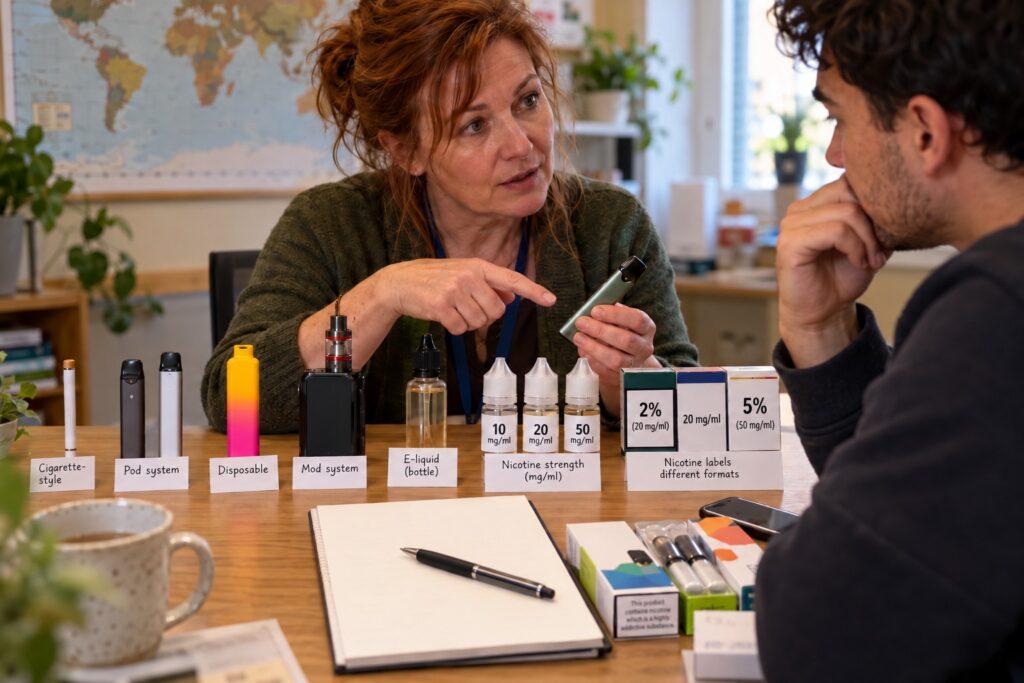
The CDC describes three main types of e-cigarette (Centers for Disease Control and Prevention [CDC], 2024):
- Disposable — pre-filled and sometimes rechargeable, but not designed to be refilled.
- Pre-filled pods or cartridges — a rechargeable device with pods that are replaced.
- Refillable — a rechargeable device with a tank or chamber filled with e-liquid from a bottle.
The type decides how you ask about amount. For a disposable, the question is how many a week and how much liquid each one holds. For pods, how many pods a week. For a tank, how many millilitres a day, or how long a bottle lasts.
“I don’t know” is a real answer, too. In the 2024 National Youth Tobacco Survey, more than one in five students who currently used e-cigarettes were not sure what type of device they used (Park-Lee et al., 2024). In my own consultations, adults often don’t know either, especially when someone else buys the product. It is worth a box of its own rather than a guess.
What the Label Can Say
E-liquid strength is usually printed in one of two ways: milligrams of nicotine per millilitre of liquid (mg/ml), or a percentage. Some products carry no usable label at all, because the packaging is gone, the product was bought from someone else, or the label is simply unclear.
The percentage is where it goes wrong. In a survey of 310 adults who vape, participants correctly compared two nicotine concentrations only about half of the time, and they did worse when a concentration was shown as a percentage than as mg/ml. They also judged percentages as weaker than the same strength written in mg/ml (Morean et al., 2021). A later study in adolescents and young adults found the same pattern and showed that clearer labels could fix much of it (Morean et al., 2022).
That is the client who says “only five percent”. The number looks small because it is a percentage.
Two Kinds of Percent
A percentage on a label can mean two different things. Weight by volume (w/v) means grams of nicotine per 100 millilitres of liquid. Weight by weight (w/w) means grams of nicotine per 100 grams of liquid (United States Pharmacopeia [USP], n.d.).
For w/v, the conversion is exact: 1% w/v is 1 gram in 100 ml, which is 10 mg/ml. So 2% w/v is 20 mg/ml.
For w/w, you need the density of the liquid, because a millilitre of e-liquid weighs more than a gram. E-liquid often contains propylene glycol and glycerine as its base (National Academies of Sciences, Engineering, and Medicine [NASEM], 2018). Propylene glycol has a specific gravity of about 1.04, and glycerine about 1.26 (National Oceanic and Atmospheric Administration [NOAA], n.d.-a, n.d.-b). Depending on the mix, 1% w/w therefore works out at somewhere between 10.4 and 12.6 mg/ml. A 5% w/w liquid is roughly 52 to 63 mg/ml.
If the label says only “5%” and not which kind, a practical working range is about 50 to 63 mg/ml, depending on how the percentage is defined.
In practice
2% ≈ 20 to 25 mg/ml
5% ≈ 50 to 63 mg/ml
If in doubt, write down exactly what the label says.
A Reference Point from the EU
In the European Union, the Tobacco Products Directive limits nicotine-containing e-liquid to 20 mg/ml, tanks and cartridges to 2 ml, and refill containers to 10 ml (European Parliament and Council of the European Union, 2014, Article 20). Rules elsewhere differ. But the EU limit is a useful reference point: a 5% w/w liquid is well above what can be legally sold in the EU.
Working It Out, Label by Label
| What the label says | How to work out mg/ml | Nicotine a day |
|---|---|---|
| mg/ml | as printed | ml a day × mg/ml |
| % w/v | % × 10 | ml a day × mg/ml |
| % w/w | % × 10.4 to % × 12.6 | a range |
| % of unknown kind | % × 10 to % × 12.6 | a range |
| No label, or don’t know | — | no figure; amount and cost only |
Two examples. A client who uses 2 ml a day of a 20 mg/ml liquid has about 40 mg of nicotine in the liquid they vape each day. A client who gets through about 0.7 ml a day of a 5% w/w pod liquid has somewhere between 36 and 44 mg. In both cases, this is nicotine in the liquid, not nicotine taken in by the body.
What the Number Is Not
This is the part to say out loud, to the client and to yourself.
The figure is nicotine in the liquid, not nicotine in the body. It is also only as good as what went into it: a label can be missing, unclear or wrong, and amounts are easy to misjudge.
So it is an indication for the conversation, not a measurement. It must not be used to choose, calculate or adjust nicotine replacement or any medication. Those decisions follow your own guidelines and clinical judgment.
Why It Is Still Worth Doing
Because the conversation changes when the client sees it. “Only five percent” becomes “that’s more than I thought”. Millilitres a day become a cost a week, a month and a year. And the label, once read properly, becomes something the client can track themselves when they start to cut down or switch.
It also changes what you ask next. A client on a strong nicotine salt liquid all day and a client on a weak liquid now and then are in different places, even if both say they “vape a bit”.
My Vaping Story puts this on paper. Page 3 records the kind of vape, the flavors, where it is bought and exactly what the label says; page 4 works out the millilitres, the nicotine and the cost by label type, with each calculation and its source listed and a clear statement of what the figures are for. The first page, how vaping began, is also free on its own: My Vaping History.
References
Centers for Disease Control and Prevention. (2024, May 15). About e-cigarettes (vapes). https://www.cdc.gov/tobacco/e-cigarettes/about.html
European Parliament and Council of the European Union. (2014). Directive 2014/40/EU on the manufacture, presentation and sale of tobacco and related products, Article 20. https://www.legislation.gov.uk/eudr/2014/40/article/20
Morean, M. E., Wackowski, O. A., Eissenberg, T., Delnevo, C. D., & Krishnan-Sarin, S. (2021). Adults who use e-cigarettes have difficulty understanding nicotine concentrations presented as mg/ml and percent nicotine. Addictive Behaviors, 120, 106965. https://doi.org/10.1016/j.addbeh.2021.106965
Morean, M. E., Wackowski, O. A., Eissenberg, T., Delnevo, C. D., Krishnan-Sarin, S., & Gueorguieva, R. (2022). Novel nicotine concentration labels improve adolescents’ and young adults’ understanding of the nicotine strength of electronic nicotine delivery system products. Nicotine & Tobacco Research, 24(7), 1110–1119. https://doi.org/10.1093/ntr/ntac024
National Academies of Sciences, Engineering, and Medicine. (2018). Public health consequences of e-cigarettes (Chapter 5, Toxicology of e-cigarette constituents). The National Academies Press. https://www.ncbi.nlm.nih.gov/books/NBK507184/
National Oceanic and Atmospheric Administration. (n.d.-a). Glycerine. CAMEO Chemicals. https://cameochemicals.noaa.gov/chemical/8708
National Oceanic and Atmospheric Administration. (n.d.-b). Propylene glycol. CAMEO Chemicals. https://cameochemicals.noaa.gov/chemical/9030
Park-Lee, E., Jamal, A., Cowan, H., et al. (2024). Notes from the field: E-cigarette and nicotine pouch use among middle and high school students — United States, 2024. MMWR. Morbidity and Mortality Weekly Report, 73, 774–778. https://www.cdc.gov/mmwr/volumes/73/wr/mm7335a3.htm
United States Pharmacopeia. (n.d.). <1160> Pharmaceutical calculations in pharmacy practice. https://www.uspnf.com/sites/default/files/usp_pdf/EN/USPNF/c1160.pdf