A practice note for cessation coaches, counselors and therapists working with clients who fear weight gain after quitting.
“I know smoking’s bad for me. I’m not stupid. But the last time I stopped, I went up two sizes before the summer. Nothing fitted. I stopped going to things because I didn’t want to be seen.
And everyone said, well, at least you’re not smoking. As if that made it fine.
So no. I’d rather smoke than go through that again. I’d honestly rather smoke than gain weight.”
It sounds like a decision. It is really a fear with a history.
The client has done the sum already, and the sum came out in favor of smoking. Not because they doubt the harm, but because the last quit cost them something no one around them took seriously: their clothes, their confidence, the parties they stopped going to. “At least you’re not smoking” told them their loss did not count.
What is actually being asked
Underneath the sentence is a question the client rarely says out loud: is there a way to stop that does not make me lose control of my body?
And, just as quietly, a test of you. Will you take the weight seriously, or will you tell them it is the lesser evil? The person in front of you is not asking for permission to keep smoking. They are asking whether this time can be different.
Why it is harder than it looks
The sentence usually ends the conversation, and there are two easy ways to end it badly. The first is reassurance: the health benefits far outweigh a few pounds. That is often true, and it is exactly what the client has already heard. The second is a plan: calories, portions, a target. That turns a quit attempt into a diet, and many clients have tried both at once and lost both.
Meanwhile the real drivers stay unnamed. Appetite and taste often change after quitting. Moments that used to end with a cigarette — after a meal, at the end of the workday, in front of the evening news — look for a new ending, and food is the one within reach. And underneath it all sits one belief: that a number on the scale means the quit was not worth it. As long as that belief stays unspoken, it wins.
What to do with it in a session
Start by taking it seriously. Not by agreeing that smoking is the answer, but by agreeing that the weight mattered. “That sounds like it cost you a lot last time” does more than any statistic.
Then ask about last time in detail. Not how much, but when. Which moments turned into eating moments? The walk home? The kitchen at ten at night? Most clients I have seen can name three or four. Those moments are the plan, not the scale.
Separate what the client feels in those moments. Some of it is hunger. Some of it is a cue: the time, the place, the hand looking for something to do. The two need different answers, and a client who can tell them apart has already taken back some of the control they were afraid of losing.
Keep the scale out of it unless the client wants it in. If they would rather not weigh themselves for now, that is a reasonable boundary, not avoidance. And if body image or eating feels overwhelming, that is a conversation for a qualified professional, alongside the quit, not after it.
The sentence underneath
Before they leave, the belief goes on paper, in the client’s own words:
The thought, exactly as it sounds in their head, and how true it feels from 0 to 10.
What has actually happened, in two columns: the times it turned out that way, and the times it did not.
An answer they choose, one sentence that holds up against both columns, and how true the old thought feels now.
The second number is often lower than the first. Not because you argued the client out of it, but because they looked at it.
Practice takeaway
When a client says they would rather smoke than gain weight, do not argue with the sum and do not hand them a diet. Take the last quit seriously, find the moments that turned into eating moments, separate hunger from cue, and put the one belief on paper where it can be tested. The goal is a quit the client can live with, not a number.
The Smoke-Free Appetite & Scale Reset is built for this appointment. Page 1 explains what changes after quitting in plain language, page 4 helps the client tell hunger from a cue, and page 3, the Cognitive Weight Ledger, puts the belief on paper with a rating before and after — and a scale boundary the client chooses for now.
A practice note for cessation coaches, counselors and therapists working with clients who slip early in a month-long quit challenge.
“I made it through Sunday. Four days. Then on Monday my brother came over, we stood outside by the back door, and I just took one from his pack. One. I didn’t even finish it.
But that’s it now, isn’t it? Stoptober is 31 days in a row, and I broke it. The app went back to zero. So I thought, fine, I’ll try again in January.
I only came today because the appointment was already booked.”
It sounds like a question about starting over. It is really a question about what the four days were worth.
The client has made a decision before the appointment: the month is broken, so the month is over. The cigarette on day five has become the verdict on days one to four. And January is not a plan. It is a way to stop thinking about it until then.
What is actually being asked
Underneath “I’ve already failed” is a narrower question: do the days before still count?
If the answer is no, stopping is logical. If the answer is yes, one cigarette is something that happened in the month, not the end of it. The person in front of you is not asking for permission to give up. They are asking whether continuing still counts.
Why it is harder than it looks
A challenge built on days in a row carries a hidden rule: one slip, and the count goes back to zero. The client did not invent that rule. The counter on their phone applied it for them.
And all-or-nothing thinking is persuasive because it brings relief. If the month is already lost, there is nothing left to hold on to tonight. That relief is what makes the next cigarette easier than the first.
Reassurance alone often slides off. “It’s only one” can sound as if you are lowering the bar. What helps more is looking at the slip closely enough that it becomes information instead of a verdict.
What to do with it in a session
Start with the four days, not the one cigarette. What got them through Thursday to Sunday? Those answers are a plan they already have.
Then look at the slip the same way. Not why they failed, but what happened: where they were, who was there, what came just before, what they needed in that moment. In this story: the back door, the brother, a pack within reach, and no plan for that hour.
The next box
Before they leave, three things go on paper:
One change for tomorrow, small enough to actually do. Not “try harder”, but “when my brother comes over, we stay inside”, or “I tell him before he lights up”.
The number of tomorrow’s box. Not day one again: day six.
One person they tell today, before it feels less awkward.
The month keeps its numbering. A slip on day five is still day five. Tomorrow is day six.
Practice takeaway
When a client says “I’ve already failed”, the first question is not why they smoked but what the days before it were made of. Count the kept days with them, look at the slip as one moment with a before and an after, and close with the number of tomorrow’s box. The work is to keep the month going, not to restart it.
Page 3 of The 31-Day Freedom Challenge Practice Set, One Day Does Not Undo the Month, is built for this exact appointment. It helps the client map what happened before the slip, what they needed in that moment, one realistic change for tomorrow, tomorrow’s box number, and the days already kept. It keeps the month moving instead of sending the client back to zero.
“I can stop for one day. I just do not know what happens when my family arrives.”
That is the consultation hidden inside the Great American Smokeout®.
In 2026, the Great American Smokeout falls on Thursday, November 19. Thanksgiving falls exactly one week later, on Thursday, November 26. That makes Thanksgiving day eight for anyone who uses the Smokeout as their quit date.
Day one is public. Day eight is private.
Day one has a name, a campaign, a reason, and a clean start. Day eight has travel, food, alcohol, family roles, old arguments, football, grief, boredom, cleanup, and somebody stepping outside after dinner.
That is why the Great American Smokeout can be more than a one-day awareness event. For practitioners, it can become a structured week-one plan.
Day eight. The table is set, and someone is stepping outside.
What the Great American Smokeout Actually Offers
The Great American Smokeout is organized by the American Cancer Society and is held each year on the third Thursday in November. The idea grew from earlier local events. The first official Smokeout was organized by the California Division of the American Cancer Society in 1976, and the American Cancer Society took it nationwide in 1977. The American Cancer Society describes it as an opportunity for people who smoke to commit to a smoke-free life, “not just for a day, but year round” (American Cancer Society, n.d.-a, n.d.-b).
In 2026, that day is November 19. Thanksgiving in the United States is the fourth Thursday of November, and in 2026 it falls on November 26 (Timeanddate.com, n.d.).
That timing matters.
A quit date is not just a date. It is a behavioral anchor. It gives the client something specific to prepare for, tell someone about, and return to after a difficult moment.
But the Smokeout is not the whole intervention. It is the opening move.
The real work is what happens in the first days after the public starting point, when nicotine withdrawal, routine disruption, and real-life triggers begin to overlap.
Why Day Eight Matters
The timing is not only symbolic.
Withdrawal symptoms such as anger, anxiety, low mood, difficulty concentrating, impatience, insomnia, and restlessness typically peak within the first week after stopping and last two to four weeks (Hughes, 2007). Day eight falls just after that peak, while many of those symptoms may still be present.
The first week is also when many quit attempts end. Among smokers who tried to quit without treatment, most relapse occurred within the first eight days. The authors concluded that cessation interventions should focus on the first week of abstinence (Hughes et al., 2004).
For a client who starts on Smokeout day, Thanksgiving lands at the end of exactly that window.
And the first week is not only about nicotine. It is about losing the small rituals that used to organize the day.
The cigarette after waking. The cigarette after food. The cigarette when the house becomes too loud. The cigarette when the conversation turns uncomfortable. The cigarette outside with someone who understands.
For many of the clients I work with, a family gathering is not just a meal. It can be a cue-rich environment: food, alcohol, stress, people who smoke, old roles, overstimulation, and emotional load. Thanksgiving can bring all of that to one table.
In a trial of an individually tailored cessation treatment, 300 women were followed through the first seven days of their quit attempt. Alcohol use, the presence of others who were smoking, and negative mood were each linked to stronger urges and a higher chance of lapse. When all three came together, urge and lapse risk were highest (Lam et al., 2014).
That does not mean Thanksgiving has to ruin the quit attempt.
It means Thanksgiving needs to be part of the quit plan before it arrives.
The First Week Is Not a Motivation Test
According to the CDC, about two in three U.S. adults who smoked in 2022 wanted to quit, and about half had tried in the past year, but fewer than one in ten quit successfully that year. Quitting often takes multiple tries, and using counseling and medication together provides the best chance of quitting successfully (Centers for Disease Control and Prevention, 2024).
That matters in practice because many of the clients I see interpret early difficulty as evidence that they are not ready.
They may say:
“I was fine until dinner.”
“I was doing well, then my brother lit up.”
“I had one after dessert, so I ruined it.”
“I knew I could not do holidays without smoking.”
The professional task is to reframe the first week.
Not: “Can this person prove they have enough willpower?” But: “Can we predict the first high-risk situation and give it a plan?”
The first week after the Great American Smokeout is a rehearsal for real life. Thanksgiving simply makes the rehearsal visible.
Day One: Make the Quit Public Enough
A quit attempt does not need to be announced to everyone. Some clients hate that. They fear pressure, embarrassment, or the feeling of being watched.
But a completely private quit can become fragile. Nobody knows why the client is irritable. Nobody knows not to offer a cigarette. Nobody knows why the person leaves the table for ten minutes.
A useful middle ground is “public enough.”
Ask the client:
Who needs to know?
Who does not need to know?
What sentence will you use if someone offers you a cigarette?
Who can help without making it a performance?
The people around a client can do more than stay out of the way. Guidance for family and friends from the UCSF Smoking Cessation Leadership Center emphasizes being there to offer support: agreeing on rules for where smoking is allowed, listening without judging, and staying positive even after a slip (University of California San Francisco Smoking Cessation Leadership Center, n.d.).
A simple sentence is often enough:
“I am using the Smokeout as my quit day. I do not need a big conversation about it, but please do not offer me one.”
That sentence does two things. It protects the quit attempt, and it protects the client from becoming the family project.
Days One to Seven: Build the Thanksgiving Map
Between Smokeout day and Thanksgiving, the client has a week to learn.
Not to become perfect. To gather data.
The most useful questions are concrete:
What time of day is hardest?
Is the craving physical, emotional, social, or routine-based?
Which cigarette do you miss most?
What do you do after meals now?
What happens when you are tired?
What happens when someone else smokes?
What would Thanksgiving add to this pattern?
This is where a worksheet helps, because the client does not have to remember everything in the consultation. They can map the pattern as it appears.
The goal is not to remove every trigger. That is not realistic.
The goal is to stop being surprised by the obvious ones.
Thanksgiving: The Four High-Risk Moments
For many clients, Thanksgiving does not create one craving. It creates several predictable moments.
1. Before arriving
This is the anticipatory cigarette: the one before entering the house, before hosting, before seeing family, before pretending everything is fine.
Practice translation: Plan the arrival. Where will the client park? What will they do with their hands before going inside? Who will they text if the urge appears before the event has even begun?
2. After eating
In my consultations, the cigarette after a meal is one of the moments clients name most often. Food, a full stomach, the chair pushed back, and then the hand reaches for the pack.
Practice translation: Replace the sequence, not only the cigarette. Stand up. Clear plates. Brush teeth. Make tea. Walk outside without smoking. Hold something else.
3. Around alcohol
Many of the clients I see say the same thing: the first drink is where the plan gets harder. In the first week of a quit attempt, drinking was associated with stronger urges and a higher chance of lapse (Lam et al., 2014). The U.S. clinical practice guideline lists drinking alcohol among the situations to recognize in advance, and advises: “Because alcohol is associated with relapse, the patient should consider limiting/abstaining from alcohol while quitting” (Agency for Healthcare Research and Quality, 2009; see also Tobacco Use and Dependence Guideline Panel, 2008).
Practice translation: Do not simply say “avoid alcohol” unless that fits the client. Ask for a specific plan: first drink delayed, alcohol-free option in hand, no drinking outside with smokers, leave before the second high-risk window.
4. The outside group
For some people, the smoking area is not about nicotine alone. It is the quieter room. The honest conversation. The break from the table. The place where the client knows how to belong.
It is also where several risks come together. In real-time reports from people trying to quit, first lapses were more likely when smoking was permitted, when cigarettes were easily available, and when other smokers were present (Shiffman et al., 1996).
Practice translation: If the client loses the cigarette, they may also lose the break. Give them a replacement exit. A walk, a dishwashing job, a phone call, a porch moment with water, or a reason to step away that does not require smoking.
A Slip Is Not the Same as a Relapse
This may be the most important sentence in the whole Thanksgiving plan.
A slip is not the same as a relapse.
MedlinePlus describes a slip as smoking one or more cigarettes and then going back to not smoking, and distinguishes it from a total relapse to full-time smoking. Its advice to patients after a slip: stop again right away, look at what led to the slip and take steps to avoid that situation in the future, keep using nicotine replacement therapy if they are using it, and remember that “a slip does not mean you failed” (MedlinePlus, 2024).
That is essential for Thanksgiving.
In my experience, what ends a quit attempt is often not the cigarette itself. It is the conclusion the client draws from it: that the attempt no longer counts.
“What happened before it?” “What did the cigarette do for you?” “What do we change for the next high-risk moment?” “How do you return to the plan tonight, not next Monday?”
The phrase I like is:
“One cigarette is information. A pack is a pattern. Let us interrupt the pattern.”
For the day after a slip, the free worksheet A Month With One Bad Day walks the client through what happened and how they carry on.
What Professionals Can Do Before Smokeout Day
The Great American Smokeout gives a practitioner a ready-made seasonal doorway. It can be used in primary care, pulmonary care, counseling, coaching, group work, workplace wellness, and community health.
The key is to avoid treating it as a motivational poster.
Use it as a structured preparation point.
A practical consultation could include:
Set November 19 as day one, if the client agrees.
Ask what Thanksgiving will look like.
Identify the top three smoking cues expected on Thanksgiving.
Decide what happens after the meal.
Decide what happens if someone offers a cigarette.
Decide what happens if there is a slip.
Review medication or nicotine replacement options within your scope and local guidance.
Arrange follow-up before or just after Thanksgiving.
That follow-up matters. A client may be proud, ashamed, confused, or exhausted after the holiday. Do not let Thanksgiving become the silent test they either pass or fail alone.
What This Means for the Worksheet
A useful Smokeout worksheet should not only ask for a quit date.
It should ask for day eight.
That is what The Eight-Day Bridge is built around. Four pages that follow the week in order:
The Eight-Day Bridge. The two dates that hold the week together: day one and day eight. One moment planned for each of the eight days, and the person who knows.
Before Day One. What leaves the house, who the client tells, the medication conversation, and the first twenty-four hours planned where it matters.
The Table Plan. Filled in a day or two before the occasion: the moments to expect, what the client drinks and how much, what happens after the meal, the sentence for when someone offers, where to go for ten minutes, and the drive home.
The Day After. How it went, what helped, a thought check if the client smoked, and the next seven days. The bridge does not end at day eight.
That last part is easy to miss.
Thanksgiving is not the finish line. It is the first real-world stress test. Day nine matters because the client needs to know the quit attempt continues after the holiday, even if the holiday was imperfect.
Day eight has an open field for the occasion. The same plan works for a Christmas dinner, a birthday, or Canadian Thanksgiving.
The Practical Message
The Great American Smokeout is day one.
Thanksgiving is day eight.
That makes 2026 a useful teaching moment for professionals. It shows the client something honest: quitting is not only about choosing a date. It is about carrying that date into the first meal, the first argument, the first drink, the first person who says, “Are you really still doing that?”
The answer does not have to be dramatic.
It can be:
“Yes. I am still doing it. I am just getting through today.”
And for many clients, that is the work.
I built The Eight-Day Bridge to hand to a client for exactly this week: two dates that hold it together, Before Day One, The Table Plan for the occasion itself, and The Day After, with a thought check for a slip and the next seven days.
Page one is free in the worksheet library. The full set of four fillable pages to use with your clients, in A4 and US Letter with a practice license, is $2.99.
I am a registered nurse in the Netherlands, qualified in asthma and COPD, with twenty-five years in pulmonary care. I work in a hospital pulmonology outpatient clinic. I am also a smoking cessation coach listed in KABIZ, the Dutch quality register for healthcare professionals, which means I work to the national care standard for tobacco and nicotine dependence.
The worksheets exist because I kept wanting to hand someone a single page that did not lecture them, and could not find one.
Evidence-informed and developed with reference to current tobacco-dependence and smoking-cessation guidelines, using CBT-informed behavioral tools to support structured cessation conversations.
Every page is built on national standards for tobacco dependence and on published evidence, and checked against the guidance in each. See the seven guidelines. Support tool only. Not medical advice, and not a substitute for the clinical judgment of the practitioner using it. Medication decisions follow your own national guidance and local cessation protocols.
New articles, case notes and worksheets are announced to the newsletter, at most once a month. Free worksheets · Practice sets
Hughes, J. R. (2007). Effects of abstinence from tobacco: Valid symptoms and time course. Nicotine & Tobacco Research, 9(3), 315–327. https://doi.org/10.1080/14622200701188919
Hughes, J. R., Keely, J., & Naud, S. (2004). Shape of the relapse curve and long-term abstinence among untreated smokers. Addiction, 99(1), 29–38. https://doi.org/10.1111/j.1360-0443.2004.00540.x
Lam, C. Y., Businelle, M. S., Aigner, C. J., McClure, J. B., Cofta-Woerpel, L., Cinciripini, P. M., & Wetter, D. W. (2014). Individual and combined effects of multiple high-risk triggers on postcessation smoking urge and lapse. Nicotine & Tobacco Research, 16(5), 569–575. https://doi.org/10.1093/ntr/ntt190
Shiffman, S., Paty, J. A., Gnys, M., Kassel, J. A., & Hickcox, M. (1996). First lapses to smoking: Within-subjects analysis of real-time reports. Journal of Consulting and Clinical Psychology, 64(2), 366–379. https://doi.org/10.1037/0022-006X.64.2.366
Tobacco Use and Dependence Guideline Panel. (2008). Treating tobacco use and dependence: 2008 update. U.S. Department of Health and Human Services. https://www.ncbi.nlm.nih.gov/books/NBK63952/
A practice note for cessation coaches, counselors and therapists working with clients whose smoking has moved into the background.
“I’m not one of those people who’s smoking all day. I’m not. I have one with my coffee and one after dinner, and those are the ones I like. The rest just — happen. I’ll be on the phone with my sister, and we’ll hang up, and there’s one in my hand. I didn’t decide that. I didn’t even want it. I’ll pull up outside the house and I’ve lit one before the engine’s off.
And then I count the pack at night and there’s fifteen gone. Fifteen. And I can tell you about two of them.
So how am I supposed to stop something I don’t even know I’m doing?”
It sounds like a question about willpower. It is really a question about sight.
What they are describing is a day with cigarettes in it that they cannot account for. They can name the first one and the one they look forward to. The rest have gone quiet. They happen, and the client finds out afterwards, counting the pack.
And underneath, the part that makes them hesitate before the quit date: if I can’t see them coming, I’ll lose to them again.
What is actually being asked
The temptation is to start with the date. Pick a day, clear the house, go.
But a quit date asks the client to fight every cigarette at once, including the ones they have never noticed. The person in front of you is not asking for more resolve. They are asking how to find the cigarettes they can’t see.
That is a much smaller question, and it has an answer.
Why it is harder than it looks
The cigarettes a client can name are the ones attached to a feeling. Stress, a craving, the one with coffee. Those at least announce themselves.
The unnoticed ones are attached to something else: the end of things. The end of a phone call. The engine turned off. The laptop closed. The last plate in the rack. The cigarette has become a full stop, and the hand reaches for it before the thought arrives.
This is why “just resist it” fails. There is nothing to resist. By the time the client notices, the moment has already passed. What looks like weak willpower is a routine that has moved so far into the background that it no longer asks permission.
What to do with it in a session
One week of noticing.
They are not asked to cut down that week. The task is to observe before trying to change. Before each cigarette, they stop for three seconds and write down two things. Where are my hands? What happened just before?
Not how many. Not whether they should have. Just where, and what came right before it.
What comes back often surprises the client more than it surprises you. The unaccounted-for cigarettes cluster. Many of them sit at the same few transitions, day after day. Once the client sees that, the question changes. It is no longer why can’t I stop? It becomes which of these do I take on first?
The first moment
They pick one ending, the one that happens most often and looks the clearest on the page. The car is a common one.
Before the next session, that moment gets a different full stop. Keys in the pocket. One slow breath with the window down. Walk to the door. The pause comes first, before anything else changes.
Some days the pause is not enough, and that is part of it. Some days it is, and the moment passes on its own.
That is the first cigarette they have skipped by choice rather than by accident. After that, it is no longer a cigarette they don’t know about. It is a moment, and a moment can be planned for.
Practice takeaway
When a client says, “I don’t even know when I do it,” the first intervention may not be a quit date. It may be a map. Ask them to notice the hands, the transition and the moment just before the cigarette. Once the pattern is visible, the work becomes smaller, clearer and more realistic.
The first page of My Smoking Story has ten everyday moments for the client to tick and a line for the one hardest to imagine giving up — a place to start the map before the first appointment.
I hear that sentence most weeks, and it is almost never the end of the story. Ask three more questions and it usually turns out the patch was 14 mg, it was worn for four days, there was nothing for the sudden cravings, and nobody explained that there should have been.
That client did not fail nicotine replacement therapy. They were never shown how to use it.
Medication is still discussed too briefly in most consultations. Some clients are afraid of side effects. Some stop early because the cravings came back anyway. Some feel that using medication means they are not really quitting by themselves. And some were simply asked “do you want medication?” and said no, because that is what you say to a question you do not understand.
So the useful question for practice is not which medication has the strongest evidence. It is how medication gets explained, matched and supported in a real quit attempt.
This is a summary of where the guidance and the recent research stand on varenicline, nicotine replacement therapy, bupropion and cytisine, and what each of those means once someone is sitting in front of you.
Patch, tablets, and someone to ask. The plan only works if the client can follow it.
What Medication Is Actually For
Medication does not make the emotional, behavioural and social layers of smoking disappear. It was never going to.
What it does is lower the biological pressure of withdrawal. That matters more than it sounds.
Most people do not go back to smoking because they lack insight. They go back because craving, low mood, irritability, broken sleep and a bad afternoon all arrive in the same week, and the cigarette is the fastest thing available. Medication puts a little more space between the urge and the hand.
That space is where your work happens. It is the room in which someone can use a coping plan, get to the next appointment, change a routine, delay an impulse, practise a different response.
Which gives a sentence worth saying out loud:
Medication does not quit for you. It steadies the body while you learn how to live without cigarettes.
Where the Guidance Stands
The WHO published its first clinical treatment guideline for tobacco cessation in adults in 2024. It recommends varenicline, nicotine replacement therapy, bupropion and cytisine as pharmacological options for people who smoke and want to stop. Varenicline, NRT and bupropion are named as first-line, and combination NRT — a patch plus a short-acting form — is listed as an option for anyone using NRT. The certainty is high for varenicline, NRT and bupropion, and moderate for combination NRT and cytisine (World Health Organization, 2024).
NICE updated its own guidance in February 2025 and added cytisinicline to the list of options that, combined with behavioural support, are more likely to result in someone stopping. That list now reads: cytisinicline, a combination of short-acting and long-acting NRT, varenicline, and nicotine-containing e-cigarettes. Bupropion remains prescribable but is not on it. NICE also sets a clear limit: cytisinicline is not to be offered to people aged 66 and over (National Institute for Health and Care Excellence, 2025).
The Canadian Task Force takes the same direction, recommending that people who smoke be offered evidence-based support including behavioural help, pharmacotherapy or both, with the choice made together (Canadian Task Force on Preventive Health Care, 2025).
The practical point underneath all three: medication is not an extra reserved for heavy smokers. It is a standard part of cessation care, and the work is in matching it to the person.
Varenicline: Strong Evidence, Poorly Explained
Varenicline remains one of the most effective options available. The evidence behind the WHO recommendation is high-certainty, and it puts varenicline ahead of placebo, ahead of bupropion, and ahead of single-form NRT (World Health Organization, 2024).
That does not mean every client should be on it. It means the conversation about it has to be a real one.
What people need to understand before they start:
why it is usually started before the quit date
that it reduces what a cigarette gives you, rather than removing the wish for one
that cravings will still happen
what to watch for, and when to contact the prescriber
why finishing the course matters
The common failure is quiet and predictable. Someone expects the medication to remove every urge, has an urge in week two, and concludes it is not working. Then they stop taking it, and then they smoke.
A better sentence to hand over at the start:
This may lower the intensity of the urge and take the reward out of smoking. You will still notice cravings. They should be easier to sit through.
Craving is not failure. If nobody says that, the client will decide it is.
NRT: Not One Product, a System
Nicotine replacement therapy gets dismissed more often than anything else, usually by people who have tried it informally and badly.
The evidence is unambiguous on one point. Cochrane found high-certainty evidence that combination NRT — a patch plus a fast-acting form such as gum or a lozenge — produces higher long-term quit rates than a single form, roughly 17 to 37 percent higher, across sixteen studies and more than twelve thousand participants (Theodoulou et al., 2023).
Which makes sense the moment you picture a day. The patch is the floor under the whole day. The gum, lozenge or spray is for the moments that break through it: the coffee, the car, after dinner, the difficult phone call.
Said plainly to a client:
The patch is the background. The gum is for the moments that come through it.
So “have you tried NRT?” is not the question. These are:
Which form did you use?
What strength, and for how long?
Did you have anything for sudden cravings?
What made you stop using it?
Did anyone explain how to combine two forms?
Nine times out of ten the answer to the last one is no.
Bupropion: Still There, With Conditions
Bupropion is still in the WHO guideline as a first-line option, and it still works. But the same guideline shows it producing lower quit rates than varenicline and lower than combination NRT, and more people leaving treatment because of side effects than with placebo (World Health Organization, 2024).
So it is not a casual suggestion. It needs a proper medication history, a contraindication check, and a prescriber who knows the person.
One question opens most of that up:
Have you ever stopped a medication because of side effects, or because it made you feel not quite yourself?
The answer tells you what to expect this time, and often prevents someone quietly stopping in week three without telling anyone.
Cytisine: Old Drug, New Attention
Cytisine has been used in central and eastern Europe for decades. What is new is the evidence behind it and the regulatory movement around it.
The ORCA-3 trial, published in 2025, gave 792 adults who smoked at least ten cigarettes a day either six weeks of cytisinicline, twelve weeks, or placebo, all with behavioural support. On the twelve-week course, 30.3 percent were abstinent in the final four weeks of treatment against 9.4 percent on placebo, and 20.5 percent against 4.2 percent were still abstinent at twenty-four weeks. Cravings dropped further than on placebo, and 1.7 percent stopped treatment because of side effects (Rigotti et al., 2025).
Treatment duration differs from the other options. NICE notes a twenty-five day course for the cytisine product licensed in the UK, against twelve weeks for varenicline. In ORCA-3 the twelve-week cytisinicline course produced higher abstinence at twenty-four weeks than the six-week course, 20.5 percent against 6.8 percent (Rigotti et al., 2025).
But availability is where this gets local. Licensing, product names, age limits and guideline status differ from country to country. NICE added cytisinicline in February 2025 and excluded people aged 66 and over. Elsewhere it may not be licensed at all (National Institute for Health and Care Excellence, 2025).
For NRT, combining is settled. Patch plus fast-acting beats one form alone, with high-certainty evidence behind it (Theodoulou et al., 2023).
For varenicline plus NRT, it is less tidy. A 2025 systematic review found low-certainty evidence that the combination may improve long-term quit rates compared with varenicline alone, and that it is generally well tolerated. Side effects were somewhat more common, and skin reactions notably so where a patch was used (Zhou et al., 2026).
Low certainty is not nothing, and it is not proof either. It means this is a conversation, not a default.
The question to hold in mind is not whether more is stronger. It is:
Would this person be helped by tighter craving control, or would a more complicated plan be the thing they abandon?
Medication only works if it gets taken.
What This Changes in the Room
The old question was: do you want medication?
It invites a no, because it asks someone to decide about a thing they have not been told anything about.
The better question is: what would make this attempt more survivable for you?
And then the ones underneath it:
What happened the last time you tried?
Did the cravings build slowly, or arrive all at once?
Did you stop the medication early? What made you stop?
Were you afraid of the side effects, or of something else?
Did you decide it was not working because you still had urges?
Do you need steady cover through the day, something for the spikes, or both?
What would make a plan feel manageable rather than one more thing to fail at?
These turn medication from a product into a plan that belongs to the person.
What a Medication Conversation Should Cover
The aim is not to talk everyone into medication. It is to make sure nobody declines it because nobody explained it.
how dependent this person actually is
previous attempts, and what happened in them
previous experience with these medications specifically
fear of side effects, named out loud
medical history and contraindications
pregnancy or breastfeeding, where relevant
mental health history, where relevant
cost and access, which decides more than we like to admit
prescription or over the counter
what behavioural support runs alongside it
Prescribing sits with whoever is licensed to do it where you work. The translating does not. That part is yours.
The Short Version
Varenicline has the strongest evidence. Combination NRT beats a single form, and most people have never been shown how. Bupropion still has a place, with screening. Cytisine is worth watching, and worth checking locally before you mention it. Combining varenicline with NRT may help some people, on low-certainty evidence, and adds side effects.
None of that answers the question practitioners actually face, which is not which medication is best.
It is which support fits this person’s dependence, fears, previous attempts, medical history and ordinary Tuesday.
Medication does not replace the conversation. Used properly, it is what makes the conversation possible.
Who Wrote This
I am a registered nurse in the Netherlands, qualified in asthma and COPD, with twenty-five years in pulmonary care. I work in a hospital pulmonology outpatient clinic. I am also a smoking cessation coach listed in KABIZ, the Dutch quality register for healthcare professionals, which means I work to the national care standard for tobacco and nicotine dependence.
The worksheets exist because I kept wanting to hand someone a single page that did not lecture them, and could not find one.
Evidence-informed and developed with reference to current tobacco-dependence and smoking-cessation guidelines, using CBT-informed behavioral tools to support structured cessation conversations.
Every page is built on national standards for tobacco dependence and on published evidence, and checked against the guidance in each. See the seven guidelines. Support tool only. Not medical advice, and not a substitute for the clinical judgment of the practitioner using it. Prescribing decisions, doses and suitability follow your own national guidance and the product information.
Questions
Which stop-smoking medication works best?
Varenicline has the strongest evidence, and combination NRT is close behind. But the medication someone will actually finish beats the one with the better trial results.
My client says patches did not work. What now?
Ask which form, what strength, for how long, and whether they had anything for sudden cravings. Most people have used a single low-dose form for a few days. That is not a fair test of NRT.
What is combination NRT?
A patch for steady background cover, plus a fast-acting form such as gum, lozenge or spray for the moments that break through. High-certainty evidence shows it produces higher long-term quit rates than a single form.
Is cytisine available where I work?
That depends entirely on your country. Licensing, product names, age limits and guideline status differ. Check locally before raising it with a client.
Can varenicline and NRT be used together?
Low-certainty evidence suggests it may improve quit rates compared with varenicline alone, with somewhat more side effects. Whether it is appropriate, and who may prescribe it, follows your own national guidance.
Does medication replace behavioural support?
No. Every guideline pairs the two. Medication lowers the biological pressure; the support is what changes the routines underneath it.
New articles, case notes and worksheets are announced to the newsletter, at most once a month. Free worksheets · Practice sets
National Institute for Health and Care Excellence. (2025). Tobacco: Preventing uptake, promoting quitting and treating dependence (NICE Guideline NG209). https://www.nice.org.uk/guidance/ng209
Rigotti, N. A., Benowitz, N. L., Prochaska, J. J., Rubinstein, M., Clarke, A., Blumenstein, B., Cain, D. F., & Jacobs, C. (2025). Cytisinicline for smoking cessation: The ORCA phase 3 replication randomized clinical trial. JAMA Internal Medicine, 185(6), 648–655. https://doi.org/10.1001/jamainternmed.2025.0628
Theodoulou, A., Chepkin, S. C., Ye, W., Fanshawe, T. R., Bullen, C., Hartmann-Boyce, J., Livingstone-Banks, J., Hajizadeh, A., & Lindson, N. (2023). Different doses, durations and modes of delivery of nicotine replacement therapy for smoking cessation. Cochrane Database of Systematic Reviews, 2023(6), Article CD013308. https://doi.org/10.1002/14651858.CD013308.pub2
Zhou, X., Huang, Z., Song, Q., Xia, X., Cheng, A., Liu, Z., Shi, S., Gao, Y., Xiao, D., & Wang, C. (2026). Efficacy of combined varenicline and nicotine replacement therapy compared with varenicline or nicotine replacement therapy alone for smoking cessation: A systematic review and meta-analysis. Addiction, 121(3), 499–509. https://doi.org/10.1111/add.70235
A practice note for cessation coaches, counselors and therapists working with clients who are quitting while a partner or housemate still smokes.
“I’d done twelve days. Twelve. And on Thursday she came in from the yard and hung her coat over the chair, and I smelled it from where I was sitting. And I sat there thinking, that’s it, that’s what I want, that’s the only thing I want. She didn’t do anything. She didn’t offer me one. She just hung up her coat.
And I hated her. Not for a second, not a flash. All evening. Through dinner, through the telly, still there when I went up. My own wife, and I was sat at my own table hating her over a coat. And I thought, this isn’t me. I’m not this person.
And I thought, I’ve earned this. Twelve days I’ve gone without. Twelve days of it, and she does nothing. She just carries on like normal. It isn’t fair.
So I had one. And then I had four more.”
It sounds like a practical problem. Smoking in the house, someone on the balcony, an ashtray on the table, the smell after dinner.
It is never only practical.
What they are also saying, most of the time, is that they are afraid this will not work, and that they will have to watch it not work from three feet away. That they are doing the hard part alone, in a house with someone who is not doing it. That they are becoming a person who counts other people’s smoking, and they do not like that person much.
And underneath that, the one nobody says out loud on the first visit: I am starting to resent her, and I do not know where to put that.
What is actually being asked
The temptation is to treat this as a relationship problem, or to make the partner the obstacle. Neither helps in the twenty minutes you have.
The person in front of you is not asking their partner to become someone else. They are asking whether this house can be made survivable for the next few weeks.
That is a much smaller question, and it has answers.
Why it is harder than it looks
In a house where one person quits and the other does not, tobacco is not just available. It is visible, on a schedule, attached to the day.
Coffee in the morning. The walk to the car. After dinner. Before bed. The old rhythm keeps running in the same room, performed by someone they love.
Several things arrive at once, and they do not arrive politely.
There is craving, triggered before there is time to think. There is envy, because the other person looks calm while they feel raw. There is resentment: I am doing the hard part and you are making it harder. And then, close behind, guilt for feeling any of it.
Underneath there is often something they will not name unless you ask. Smoking may have been a shared thing. Fifteen minutes outside together, twice a day, for years. Quitting removes that before anything has replaced it. What looks like craving is sometimes loss.
This is why “just ignore it” fails. They are not resisting tobacco. They are resisting the shape of their own evening.
What to do with it in a session
Three requests, not a conversation about the relationship.
Ask them to name specific, physical changes in the house. Outside only. Out of sight. Never offered, not even as a joke. Hands washed before close contact.
Each one is about the room, not about the person. That distinction is what makes it possible to ask.
Then do the part most people skip: plan for no.
Ask directly. What will you do if they say no, or say yes and forget by Thursday? If the plan depends on someone else keeping a promise, the plan is not theirs.
What holds instead is small and theirs alone. Ten minutes in another room. Something in the hands. A sentence practiced in advance for when it is offered. And one rule that saves more attempts than any other: do not start the big conversation during a craving.
The single conversation
The bigger talk is worth having once. Not mid-craving, not after an argument, not while the partner is standing there smoking.
They pick a moment. Three requests. And one line that makes the whole thing possible to hear:
I am not asking you to quit. I am asking for a few things in the house so I can get through this.
After that, they watch what actually happens, and they build around what they see rather than what they hoped for.
Practice takeaway
When a client says their partner still smokes, the first question is not how to change the partner. It is whether the house can be made survivable for the next few weeks. Three requests about the room rather than the person, a plan for when the answer is no, and one conversation held once, never during a craving. After that, build around what actually happens, not around what was promised.
I built the Mixed-Habit Household Plan for exactly this: house boundaries, a plan for no, the ten-minute move, prepared responses, and a thought record for the weeks when the story about the partner takes over.
Four printable, fillable worksheets, in A4 and US Letter, with a practice license included.
Every autumn the same conversation comes back. A client who has been thinking about stopping for months finally says it out loud, and then adds: not right now, though. There is a birthday coming up. Work is busy. January might be better.
The thinking is never the problem. The starting is.
Stoptober exists because of exactly that gap. It is worth knowing what it is, what the evidence behind it actually says, and, if it does not run in your country, how to use the part that does the work.
What Stoptober Is
Stoptober began in England in 2012. The idea was deliberately narrow: get people to stop smoking on the same day, and stay stopped for twenty-eight days.
Not forever. Twenty-eight days.
The campaign was built around a fixed start date of October 1, public messaging, an app, text support, and the visible fact that thousands of other people were starting at the same moment. It was not built on fear. The message was closer to: begin together, aim for a month, use the support that exists.
The 2026 campaign adds three new content themes — mental health, Closer Each Time, and For Everyone — under the standing tagline Let’s Quit Smoking Together. The second of those tackles the stigma of needing more than one attempt.
A month has a shape. October 2026 begins on a Thursday and ends on a Saturday.
Where Stoptober Runs
Stoptober is an English campaign, run for smokers in England.
Versions of it have been adopted elsewhere after the first evaluation came back positive: the Netherlands, France (as Mois sans tabac, which runs in November), and New Zealand have all run their own. The Dutch campaign has been running since 2014, and I have worked through more than ten of them from inside the clinic, which is where most of what follows comes from.
In the United States, Canada, Ireland, and Australia there is no comparable national campaign with the same October structure. There are other moments. The Great American Smokeout falls on the third Thursday of November, which is November 19 in 2026. But there is no shared October month.
That does not put October out of reach. What makes the model work is not the branding. It is the structure underneath it, and the structure is portable.
What the Research Actually Found
The first campaign was evaluated using quit-attempt data from 31,566 smokers, collected through monthly household surveys in England between 2007 and 2012 (Brown et al., 2014).
The findings: Stoptober raised the odds of someone making a quit attempt in October by around 80 percent, and generated an estimated 350,000 additional quit attempts. Modeled out, that came to roughly 10,400 discounted life years saved, at under £415 each in the largest age group, which is favorable compared to other campaigns of the period (Brown et al., 2014).
A later study looked at England across 2012 to 2017 and found more quit attempts in October across the period as a whole, though not consistently from one campaign to the next. The increase appeared larger when the campaign budget was higher, although the authors describe that particular analysis as not conclusive (Kuipers et al., 2020). That is a useful detail: the effect is not magic, and it seems to track with how loudly the message is carried.
In the Netherlands, the 2014 to 2016 campaigns were associated with a short-term rise in people searching online for help with quitting, on a scale comparable to the rise around New Year (Tieks et al., 2019).
One thing the evaluations cited here do not show is that twenty-eight days makes anyone five times more likely to stop permanently. That figure comes from campaign communication rather than from these studies. It is worth knowing which is which before repeating it to a client.
Why a Fixed Date Does Something a Good Conversation Cannot
Ask someone to stop smoking and you are asking them to give up something for the rest of their life. That is an enormous request, and most people have already failed at it at least once.
Ask someone to stop for October and the request changes shape. It has an end. It is survivable. It can be attempted by someone who does not yet believe they can succeed, which describes most people sitting in front of you.
The rest of what the campaign supplies is ordinary and easy to reproduce:
a start date that is not negotiable and not chosen by the client
a period short enough to picture from the beginning
other people doing it at the same time
something to mark each day on
a way back in after a bad day, instead of a verdict
None of that requires a national budget. Most of it fits inside a normal appointment.
Running an October Month Without an Official Campaign
If Stoptober is not a thing where you work, you can still use the shape of it. What you need is a date, a way to count, and a plan for the day it goes wrong.
September is the preparation. Set the quit date in advance and write it down. Identify the three hardest moments the client already knows are coming. Decide now what happens instead. Clear the house before day one rather than on day one.
October is the counting. One box per day. The client is not deciding about the rest of their life at breakfast. They are deciding about today.
The slip is data, not a verdict. This is where most quit months are actually lost. Not on the day someone smokes, but on the day after, when they decide the month is ruined. A month with one bad day in it is still a month.
For a group, the only extra ingredient is that everyone starts on the same date. That is the whole social mechanism, and it works in a waiting room as well as it works on national television.
The Three Days the Campaign Does Not Cover
Stoptober asks for twenty-eight days. October has thirty-one.
Those last three days are not a rounding error. They are the days when the campaign has finished, the messages stop arriving, the group has gone quiet, and the person is still not smoking, alone this time, without the scaffolding that got them there.
Anyone who has worked in cessation recognizes the pattern in November.
That is why the worksheet below runs to the end of the month rather than to day twenty-eight. Not as a criticism of the campaign, which does something no individual practitioner can. As the part that comes after it.
A Free 31-Day Worksheet for Your Clients
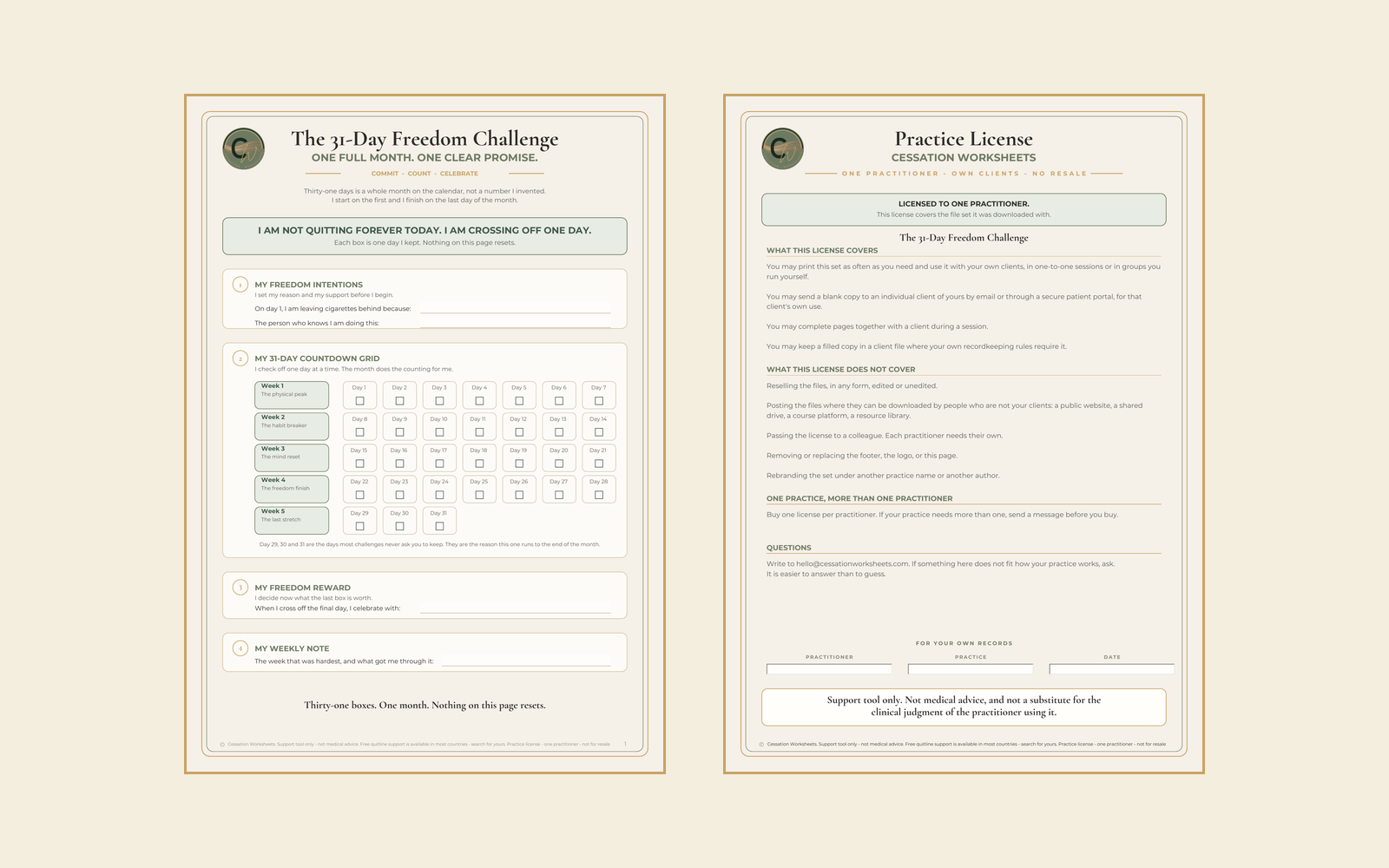
The 31-Day Freedom Challenge is a free, fillable worksheet built for exactly this: a client, a month, and one box per day.
One page, in four parts. My Freedom Intentions: the reason, and the person who knows. My 31-Day Countdown Grid: thirty-one boxes in five weeks, each week named for what it tends to be — the physical peak, the habit breaker, the mind reset, the freedom finish, the last stretch. My Freedom Reward, decided in advance. And My Weekly Note, for the week that was hardest and what got the client through it.
Across the top of the page, one line: I am not quitting forever today. I am crossing off one day. Nothing on the page resets.
It comes in US Letter and A4, both digitally fillable in Acrobat Reader on a phone or tablet, and both fine to print.
The download includes a practice license. One practitioner, your own clients, in session, as homework, or in a group you run yourself. Print it as often as you need, or send a blank copy to an individual client. The license page is included in the file, with space for your name, your practice, and the date.
The worksheet and the license page, both in A4 and US Letter.
Who Wrote This
I am a registered nurse in the Netherlands, qualified in asthma and COPD, with twenty-five years in pulmonary care. I work in a hospital pulmonology outpatient clinic. I am also a smoking cessation coach listed in KABIZ, the Dutch quality register for healthcare professionals, which means I work to the national care standard for tobacco and nicotine dependence.
The worksheets exist because I kept wanting to hand someone a single page that did not lecture them, and could not find one.
Evidence-informed and developed with reference to current tobacco-dependence and smoking-cessation guidelines, using CBT-informed behavioral tools to support structured cessation conversations.
Every page is developed with reference to tobacco-dependence guidance and published evidence. See the seven guidelines. Support tool only. Not medical advice, and not a substitute for the clinical judgment of the practitioner using it.
Questions
What is Stoptober?
An October stop-smoking challenge. Participants stop together on October 1 and aim to stay smoke-free for twenty-eight days.
Does Stoptober run in my country?
It runs in England and the Netherlands, and versions have run in France (in November) and New Zealand. There is no comparable national October campaign in the United States, Canada, Ireland, or Australia, but the structure works without one.
Can I run an October challenge without being part of an official campaign?
Yes, and it is worth being plain with clients about it: this is the same idea, run in this practice, not a government program. A fixed date, a month, and something to count on is the working part.
Who can use the free worksheet?
Any practitioner supporting someone through a quit attempt: coaches, counselors, therapists, nurses, quit advisors, group facilitators.
What does the practice license allow?
One practitioner may use the set with their own clients: in one-to-one sessions, as homework, or in a group they run themselves. You may print it as often as you need, send a blank copy to an individual client of yours, complete pages together in session, and keep a filled copy in a client file where your recordkeeping rules require it.
What does the license not allow?
Reselling or rebranding the set, posting it where people who are not your clients can download it, or passing it to a colleague. A colleague can download their own copy. It is free.
Can I use it with a group?
Yes, if it is a group you run yourself.
Is it medical advice?
No. It is a support tool. It does not replace clinical judgment, medication guidance, or the assessment you would make yourself.
New articles, case notes and worksheets are announced to the newsletter, at most once a month. Free worksheets · Practice sets
References
Brown, J., Kotz, D., Michie, S., Stapleton, J., Walmsley, M., & West, R. (2014). How effective and cost-effective was the national mass media smoking cessation campaign ‘Stoptober’? Drug and Alcohol Dependence, 135, 52–58. https://doi.org/10.1016/j.drugalcdep.2013.11.003
Kuipers, M. A. G., West, R., Beard, E. V., & Brown, J. (2020). Impact of the “Stoptober” smoking cessation campaign in England from 2012 to 2017: A quasiexperimental repeat cross-sectional study. Nicotine & Tobacco Research, 22(9), 1453–1459. https://doi.org/10.1093/ntr/ntz108
Tieks, A., Troelstra, S. A., Hoekstra, T., & Kunst, A. E. (2019). Associations of the Stoptober smoking cessation program with information seeking for smoking cessation: A Google trends study. Drug and Alcohol Dependence, 194, 97–100. https://doi.org/10.1016/j.drugalcdep.2018.08.040