
Description
“I can do the first few days. It’s Thursday I’m worried about. The whole family will be there.” The client is not asking whether to quit. They are asking what to do at the table.
For clinicians, coaches and quit advisors
Plenty of worksheets let you print and use them with clients. This one does too. Here is what it adds.
- You may give a client their own blank copy to keep, by email or through a secure patient portal.
- You may use it in groups you run yourself.
- You may print without limit, for as long as you practice.
- And a written license page comes as a separate sheet in the download, so your practice has something to file.
One practitioner. Not transferable to a colleague, and not for resale.
The free page, and what this set adds
Page 1, the eight-day plan, is also in the free library on its own. You can use it with clients as it is.
This set, for $2.99, adds the three pages around it: the week before day one, the occasion itself, and the day after. Those are the moments a one-page plan does not cover.
Written for smoking cessation
Not a holiday planner with a line about smoking added. Every page is built around one situation: a quit date that falls a week before a family gathering — by a nurse with twenty-five years in pulmonary care who is also a certified quit coach.
Why eight days, and a plan for the table
A big occasion in the same week can look like a reason to put the quit date off. This set treats it as a date to plan toward. Day one is the quit day. Day eight is the gathering. The days in between each get one moment, planned in advance.
A gathering brings several hard moments together: the first minutes after arriving, drinks before the meal, the end of the meal, others stepping outside to smoke, tension at the table, the quiet after everyone leaves. Page 3 lists them so the client can tick the ones that apply, and decides the answers before they arrive rather than at the table.
Day eight does not have to be a holiday. The occasion is a blank field: a holiday meal, a birthday, a family table. In 2026 the Great American Smokeout falls on November 19 and Thanksgiving on November 26, exactly eight days apart.
What you get
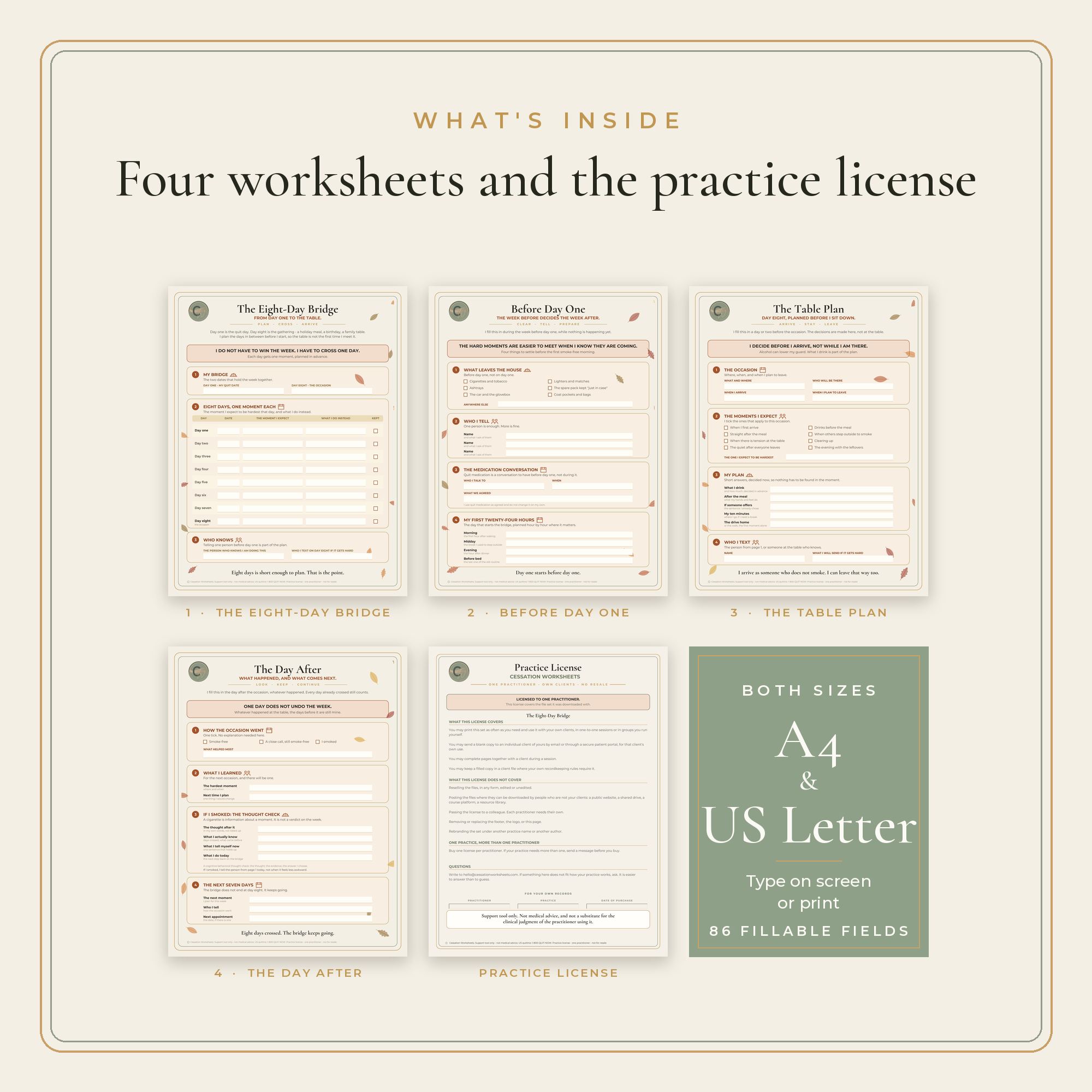
Four pages — US Letter and A4 both included — 86 fillable fields.
Plus the license page, in both sizes.
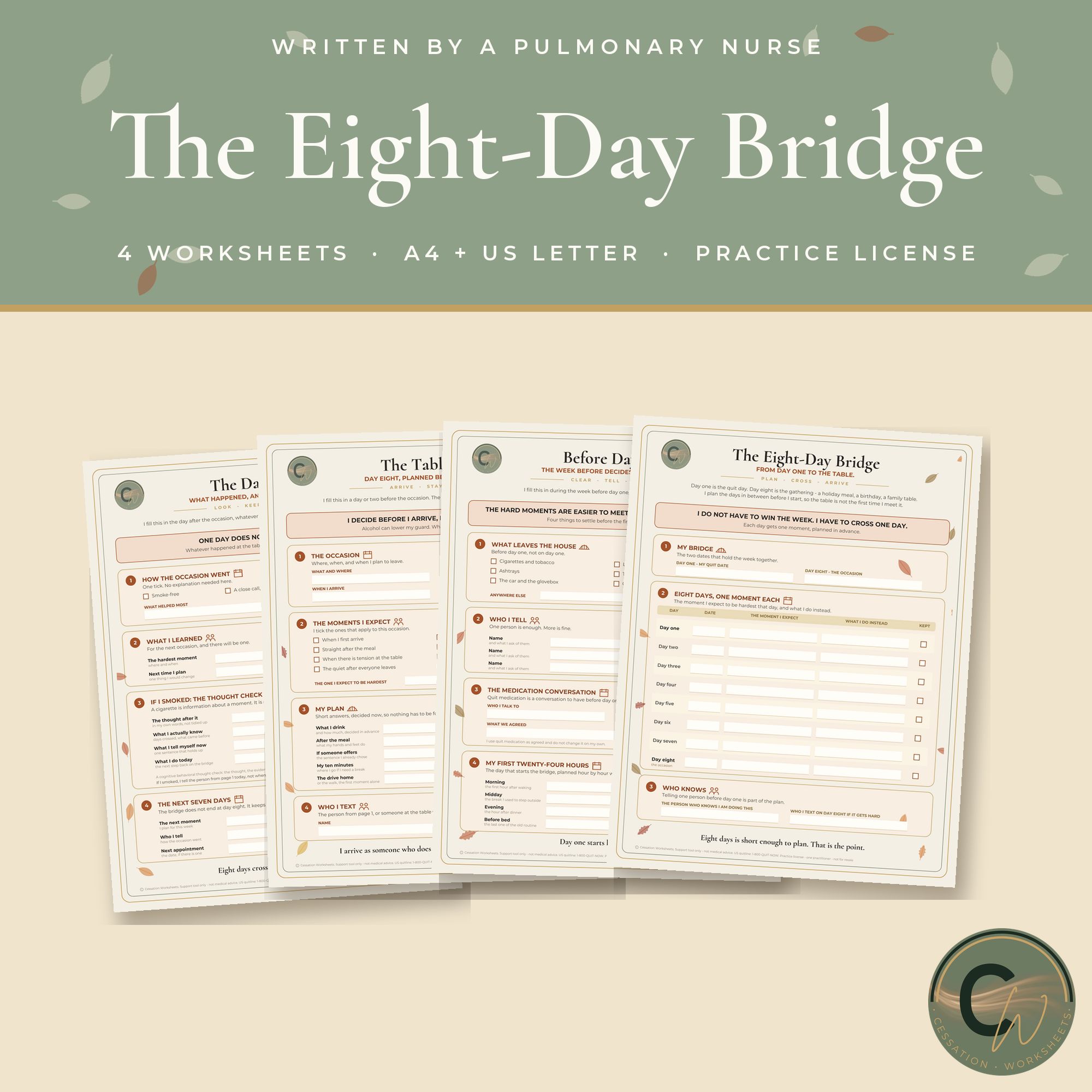
1 — The Eight-Day Bridge
The two dates that hold the week together: the quit date and the occasion. Eight rows, one per day, with the date, the moment the client expects to be hardest that day, what they do instead, and a box to tick when it was kept. The person who knows they are doing this, and who they text on day eight if it gets hard.
2 — Before Day One
Filled in during the week before the quit date. What leaves the house before day one — cigarettes, lighters, ashtrays, the spare pack, the car and the glovebox, coat pockets and bags. Who they tell, and what they ask of each person. The medication conversation, held before day one: who with, when, and what was agreed. The first twenty-four hours, planned where it matters: the first hour after waking, the break where they used to step outside, the hour after dinner, the last one of the old routine.
3 — The Table Plan
Filled in a day or two before the occasion. Where, when, who will be there, and when they plan to leave. The moments they expect, ticked from a list of eight, and the one they expect to be hardest. Then five short answers decided in advance: what they drink and how much, what their hands and feet do after the meal, the sentence they say if someone offers, where they go for ten minutes if they need a break, and the drive or walk home. The page notes that alcohol can lower their guard, so what they drink is part of the plan.
4 — The Day After
Filled in the day after the occasion, whatever happened. One tick: smoke-free, a close call, or smoked. What helped most, the hardest moment, and one thing to change next time. If they smoked, a thought check: the thought after it in their own words, what they actually know, one sentence that holds up, and the next step back. Then the next seven days, because the bridge does not end at day eight.
How it sits in a session
Pages 1 and 2 work together in an appointment before the quit date. Page 1 sets the eight days. Page 2 is filled in during the week before day one, so it works best with a week to spare.
Page 3 is homework for the day or two before the occasion. It can also be filled in together if there is an appointment that week.
Page 4 is the page to open the next appointment with. It starts with one tick and no explanation needed.
The pages use CBT-informed relapse prevention tools: stimulus control on page 2 (what leaves the house before day one), high-risk situation planning and a coping plan decided in advance on page 3, and a cognitive behavioral thought check on page 4 — the thought, the evidence, the answer the client chooses.
Nothing on these pages asks the client to disclose more than they choose to. There are no diagnostic items and nothing is scored.
Three ways to use it
- Hand a client page 1 on its own, or all four.
- They type straight into it on a phone or tablet.
- Or print it and use a pen.
Two sizes, both fillable
US Letter, 8.5 x 11 in — United States and Canada
A4, 210 x 297 mm — the standard size everywhere else
Both are in the download at no extra cost, and both work the same way: type on screen, or print. The fields do not show on paper.
Before you start
Open the file in Adobe Acrobat Reader — it’s free, on iPhone, Android, Mac and Windows. A browser preview will show the pages, but it won’t reliably keep what a client types.
Keep the blank original blank. Save filled copies under a new name.
The practice license
One practitioner, unlimited clients, worldwide. Print for your own clients, use one-to-one and in groups you run yourself, send a blank copy to an individual client, and keep a filled copy in a client file where your recordkeeping rules require it. Not for resale, and not transferable to a colleague — each practitioner needs their own. The full terms come as a separate page in the download.
Personalized license copy, on request
The license page carries the name of this set and has fields for your name, your practice, and the date of purchase, so you can complete it yourself and keep it with your records. If you would rather have those details typeset into the page instead of typed into a form field, write to hello@cessationworksheets.com after your purchase and I will send one back. No charge — it is part of the license.
How buying works
Checkout runs through Gumroad, a payment platform used by independent creators worldwide. You pay on their secure checkout page, and your card details never reach me.
The price shown here is $2.99 before tax. VAT or sales tax is added at checkout, based on where you live, so the total can differ from country to country. You see the full amount before you pay.
Charges are processed in US dollars. Outside the United States, your bank converts the amount and may add a small fee of its own.
Straight after payment you get a download link on screen and by email, with both files — A4 and US Letter — and a receipt.
Who wrote this
I am a pulmonary nurse, trained in asthma and COPD. I work in a respiratory outpatient clinic, where I see people with asthma and COPD and run the smoking cessation consultations. I am listed in KABIZ, the Dutch quality register for healthcare professionals, which means I work to the national care standard for tobacco and nicotine dependence.
Evidence-informed and developed with reference to current tobacco-dependence and smoking-cessation guidelines, using CBT-informed behavioral tools to support structured cessation conversations.
Every page is built on national standards for tobacco dependence and on published evidence, and checked against the guidance in each. See the seven guidelines.
No lectures. No scare tactics.
Instant digital download. Nothing is shipped. No refunds once the download has been opened. If the file does not work as described, write to me and I will sort it out.
Support tool only — not medical advice, and not a substitute for the clinical judgment of the practitioner using it.