A practice note for cessation coaches, counselors and therapists working with clients who slip early in a month-long quit challenge.
“I made it through Sunday. Four days. Then on Monday my brother came over, we stood outside by the back door, and I just took one from his pack. One. I didn’t even finish it.
But that’s it now, isn’t it? Stoptober is 31 days in a row, and I broke it. The app went back to zero. So I thought, fine, I’ll try again in January.
I only came today because the appointment was already booked.”
It sounds like a question about starting over. It is really a question about what the four days were worth.
The client has made a decision before the appointment: the month is broken, so the month is over. The cigarette on day five has become the verdict on days one to four. And January is not a plan. It is a way to stop thinking about it until then.
What is actually being asked
Underneath “I’ve already failed” is a narrower question: do the days before still count?
If the answer is no, stopping is logical. If the answer is yes, one cigarette is something that happened in the month, not the end of it. The person in front of you is not asking for permission to give up. They are asking whether continuing still counts.
Why it is harder than it looks
A challenge built on days in a row carries a hidden rule: one slip, and the count goes back to zero. The client did not invent that rule. The counter on their phone applied it for them.
And all-or-nothing thinking is persuasive because it brings relief. If the month is already lost, there is nothing left to hold on to tonight. That relief is what makes the next cigarette easier than the first.
Reassurance alone often slides off. “It’s only one” can sound as if you are lowering the bar. What helps more is looking at the slip closely enough that it becomes information instead of a verdict.
What to do with it in a session
Start with the four days, not the one cigarette. What got them through Thursday to Sunday? Those answers are a plan they already have.
Then look at the slip the same way. Not why they failed, but what happened: where they were, who was there, what came just before, what they needed in that moment. In this story: the back door, the brother, a pack within reach, and no plan for that hour.
The next box
Before they leave, three things go on paper:
One change for tomorrow, small enough to actually do. Not “try harder”, but “when my brother comes over, we stay inside”, or “I tell him before he lights up”.
The number of tomorrow’s box. Not day one again: day six.
One person they tell today, before it feels less awkward.
The month keeps its numbering. A slip on day five is still day five. Tomorrow is day six.
Practice takeaway
When a client says “I’ve already failed”, the first question is not why they smoked but what the days before it were made of. Count the kept days with them, look at the slip as one moment with a before and an after, and close with the number of tomorrow’s box. The work is to keep the month going, not to restart it.
Page 3 of The 31-Day Freedom Challenge Practice Set, One Day Does Not Undo the Month, is built for this exact appointment. It helps the client map what happened before the slip, what they needed in that moment, one realistic change for tomorrow, tomorrow’s box number, and the days already kept. It keeps the month moving instead of sending the client back to zero.
Every autumn the same conversation comes back. A client who has been thinking about stopping for months finally says it out loud, and then adds: not right now, though. There is a birthday coming up. Work is busy. January might be better.
The thinking is never the problem. The starting is.
Stoptober exists because of exactly that gap. It is worth knowing what it is, what the evidence behind it actually says, and, if it does not run in your country, how to use the part that does the work.
What Stoptober Is
Stoptober began in England in 2012. The idea was deliberately narrow: get people to stop smoking on the same day, and stay stopped for twenty-eight days.
Not forever. Twenty-eight days.
The campaign was built around a fixed start date of October 1, public messaging, an app, text support, and the visible fact that thousands of other people were starting at the same moment. It was not built on fear. The message was closer to: begin together, aim for a month, use the support that exists.
The 2026 campaign adds three new content themes — mental health, Closer Each Time, and For Everyone — under the standing tagline Let’s Quit Smoking Together. The second of those tackles the stigma of needing more than one attempt.
A month has a shape. October 2026 begins on a Thursday and ends on a Saturday.
Where Stoptober Runs
Stoptober is an English campaign, run for smokers in England.
Versions of it have been adopted elsewhere after the first evaluation came back positive: the Netherlands, France (as Mois sans tabac, which runs in November), and New Zealand have all run their own. The Dutch campaign has been running since 2014, and I have worked through more than ten of them from inside the clinic, which is where most of what follows comes from.
In the United States, Canada, Ireland, and Australia there is no comparable national campaign with the same October structure. There are other moments. The Great American Smokeout falls on the third Thursday of November, which is November 19 in 2026. But there is no shared October month.
That does not put October out of reach. What makes the model work is not the branding. It is the structure underneath it, and the structure is portable.
What the Research Actually Found
The first campaign was evaluated using quit-attempt data from 31,566 smokers, collected through monthly household surveys in England between 2007 and 2012 (Brown et al., 2014).
The findings: Stoptober raised the odds of someone making a quit attempt in October by around 80 percent, and generated an estimated 350,000 additional quit attempts. Modeled out, that came to roughly 10,400 discounted life years saved, at under £415 each in the largest age group, which is favorable compared to other campaigns of the period (Brown et al., 2014).
A later study looked at England across 2012 to 2017 and found more quit attempts in October across the period as a whole, though not consistently from one campaign to the next. The increase appeared larger when the campaign budget was higher, although the authors describe that particular analysis as not conclusive (Kuipers et al., 2020). That is a useful detail: the effect is not magic, and it seems to track with how loudly the message is carried.
In the Netherlands, the 2014 to 2016 campaigns were associated with a short-term rise in people searching online for help with quitting, on a scale comparable to the rise around New Year (Tieks et al., 2019).
One thing the evaluations cited here do not show is that twenty-eight days makes anyone five times more likely to stop permanently. That figure comes from campaign communication rather than from these studies. It is worth knowing which is which before repeating it to a client.
Why a Fixed Date Does Something a Good Conversation Cannot
Ask someone to stop smoking and you are asking them to give up something for the rest of their life. That is an enormous request, and most people have already failed at it at least once.
Ask someone to stop for October and the request changes shape. It has an end. It is survivable. It can be attempted by someone who does not yet believe they can succeed, which describes most people sitting in front of you.
The rest of what the campaign supplies is ordinary and easy to reproduce:
a start date that is not negotiable and not chosen by the client
a period short enough to picture from the beginning
other people doing it at the same time
something to mark each day on
a way back in after a bad day, instead of a verdict
None of that requires a national budget. Most of it fits inside a normal appointment.
Running an October Month Without an Official Campaign
If Stoptober is not a thing where you work, you can still use the shape of it. What you need is a date, a way to count, and a plan for the day it goes wrong.
September is the preparation. Set the quit date in advance and write it down. Identify the three hardest moments the client already knows are coming. Decide now what happens instead. Clear the house before day one rather than on day one.
October is the counting. One box per day. The client is not deciding about the rest of their life at breakfast. They are deciding about today.
The slip is data, not a verdict. This is where most quit months are actually lost. Not on the day someone smokes, but on the day after, when they decide the month is ruined. A month with one bad day in it is still a month.
For a group, the only extra ingredient is that everyone starts on the same date. That is the whole social mechanism, and it works in a waiting room as well as it works on national television.
The Three Days the Campaign Does Not Cover
Stoptober asks for twenty-eight days. October has thirty-one.
Those last three days are not a rounding error. They are the days when the campaign has finished, the messages stop arriving, the group has gone quiet, and the person is still not smoking, alone this time, without the scaffolding that got them there.
Anyone who has worked in cessation recognizes the pattern in November.
That is why the worksheet below runs to the end of the month rather than to day twenty-eight. Not as a criticism of the campaign, which does something no individual practitioner can. As the part that comes after it.
A Free 31-Day Worksheet for Your Clients
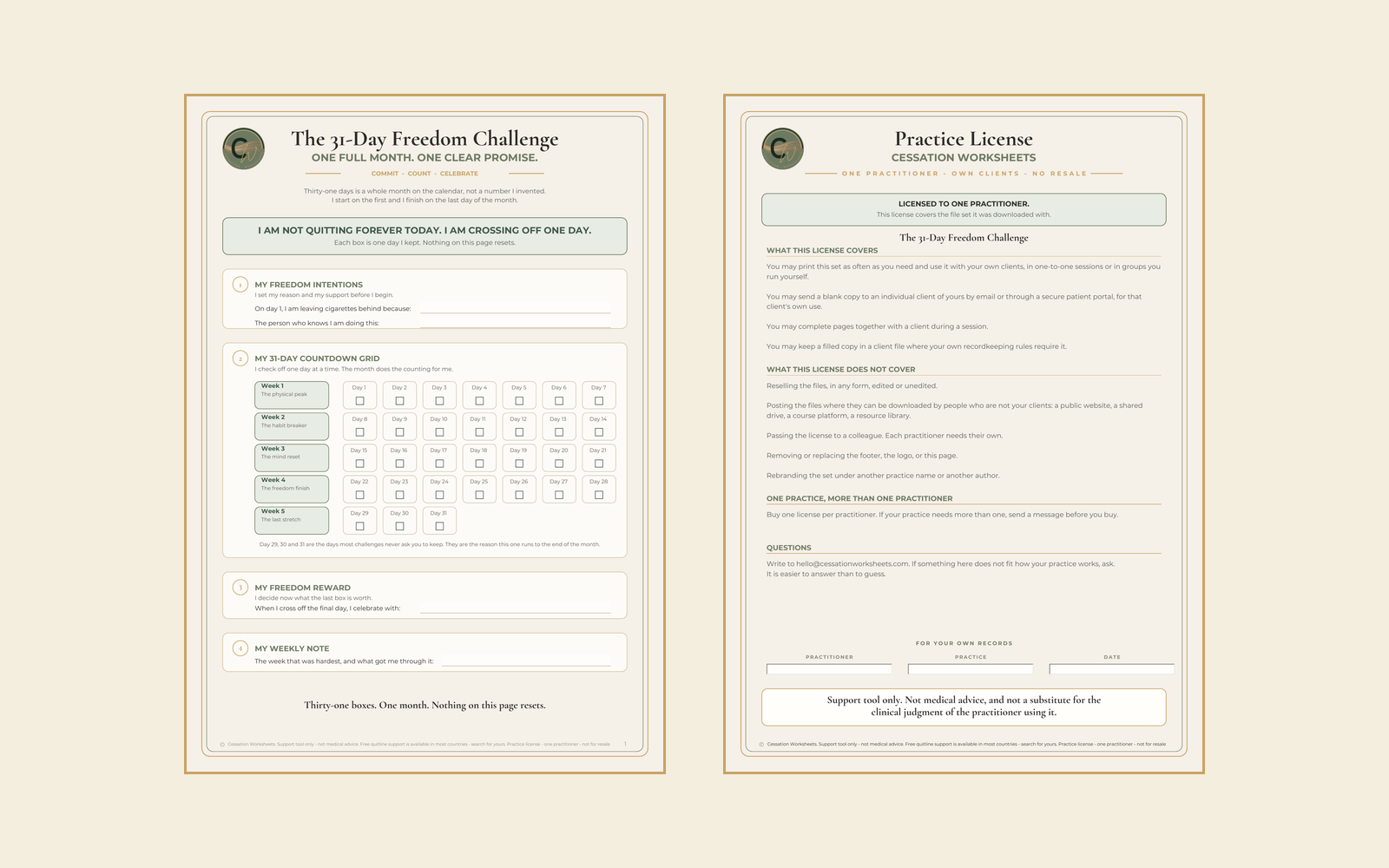
The 31-Day Freedom Challenge is a free, fillable worksheet built for exactly this: a client, a month, and one box per day.
One page, in four parts. My Freedom Intentions: the reason, and the person who knows. My 31-Day Countdown Grid: thirty-one boxes in five weeks, each week named for what it tends to be — the physical peak, the habit breaker, the mind reset, the freedom finish, the last stretch. My Freedom Reward, decided in advance. And My Weekly Note, for the week that was hardest and what got the client through it.
Across the top of the page, one line: I am not quitting forever today. I am crossing off one day. Nothing on the page resets.
It comes in US Letter and A4, both digitally fillable in Acrobat Reader on a phone or tablet, and both fine to print.
The download includes a practice license. One practitioner, your own clients, in session, as homework, or in a group you run yourself. Print it as often as you need, or send a blank copy to an individual client. The license page is included in the file, with space for your name, your practice, and the date.
The worksheet and the license page, both in A4 and US Letter.
Who Wrote This
I am a registered nurse in the Netherlands, qualified in asthma and COPD, with twenty-five years in pulmonary care. I work in a hospital pulmonology outpatient clinic. I am also a smoking cessation coach listed in KABIZ, the Dutch quality register for healthcare professionals, which means I work to the national care standard for tobacco and nicotine dependence.
The worksheets exist because I kept wanting to hand someone a single page that did not lecture them, and could not find one.
Evidence-informed and developed with reference to current tobacco-dependence and smoking-cessation guidelines, using CBT-informed behavioral tools to support structured cessation conversations.
Every page is developed with reference to tobacco-dependence guidance and published evidence. See the seven guidelines. Support tool only. Not medical advice, and not a substitute for the clinical judgment of the practitioner using it.
Questions
What is Stoptober?
An October stop-smoking challenge. Participants stop together on October 1 and aim to stay smoke-free for twenty-eight days.
Does Stoptober run in my country?
It runs in England and the Netherlands, and versions have run in France (in November) and New Zealand. There is no comparable national October campaign in the United States, Canada, Ireland, or Australia, but the structure works without one.
Can I run an October challenge without being part of an official campaign?
Yes, and it is worth being plain with clients about it: this is the same idea, run in this practice, not a government program. A fixed date, a month, and something to count on is the working part.
Who can use the free worksheet?
Any practitioner supporting someone through a quit attempt: coaches, counselors, therapists, nurses, quit advisors, group facilitators.
What does the practice license allow?
One practitioner may use the set with their own clients: in one-to-one sessions, as homework, or in a group they run themselves. You may print it as often as you need, send a blank copy to an individual client of yours, complete pages together in session, and keep a filled copy in a client file where your recordkeeping rules require it.
What does the license not allow?
Reselling or rebranding the set, posting it where people who are not your clients can download it, or passing it to a colleague. A colleague can download their own copy. It is free.
Can I use it with a group?
Yes, if it is a group you run yourself.
Is it medical advice?
No. It is a support tool. It does not replace clinical judgment, medication guidance, or the assessment you would make yourself.
New articles, case notes and worksheets are announced to the newsletter, at most once a month. Free worksheets · Practice sets
References
Brown, J., Kotz, D., Michie, S., Stapleton, J., Walmsley, M., & West, R. (2014). How effective and cost-effective was the national mass media smoking cessation campaign ‘Stoptober’? Drug and Alcohol Dependence, 135, 52–58. https://doi.org/10.1016/j.drugalcdep.2013.11.003
Kuipers, M. A. G., West, R., Beard, E. V., & Brown, J. (2020). Impact of the “Stoptober” smoking cessation campaign in England from 2012 to 2017: A quasiexperimental repeat cross-sectional study. Nicotine & Tobacco Research, 22(9), 1453–1459. https://doi.org/10.1093/ntr/ntz108
Tieks, A., Troelstra, S. A., Hoekstra, T., & Kunst, A. E. (2019). Associations of the Stoptober smoking cessation program with information seeking for smoking cessation: A Google trends study. Drug and Alcohol Dependence, 194, 97–100. https://doi.org/10.1016/j.drugalcdep.2018.08.040