
Description
“I know how it sounds, but I miss it.” Most clients apologize before they say that sentence. Grieving a habit is hard to admit out loud, and harder to work with if it never gets said.
For clinicians, coaches and quit advisors
Plenty of worksheets let you print and use them with clients. This one does too. Here is what it adds.
- You may give a client their own blank copy to keep, by email or through a secure patient portal.
- You may use it in groups you run yourself.
- You may print without limit, for as long as you practice.
- And a written license page comes as a separate sheet in the download, so your practice has something to file.
One practitioner. Not transferable to a colleague, and not for resale.
Written for smoking cessation
Not adapted from general therapy material. Every page was built for the loss a client feels when the thing they are giving up was also the thing that showed up every day — by a nurse with twenty-five years in pulmonary care who is also a certified quit coach.
Why grief, and not willpower
A client who has smoked for thirty years is not only giving up harm. They are losing something that arrived at the same moments every day, asked nothing, and never let them down.
That loss is rarely named in a quit plan, and it is often the reason a plan that looked solid stops working in week three. Naming it is not indulgence. Once the need behind the moment is on paper it can be answered by something else. As long as it stays unnamed, only one thing answers it.
What you get
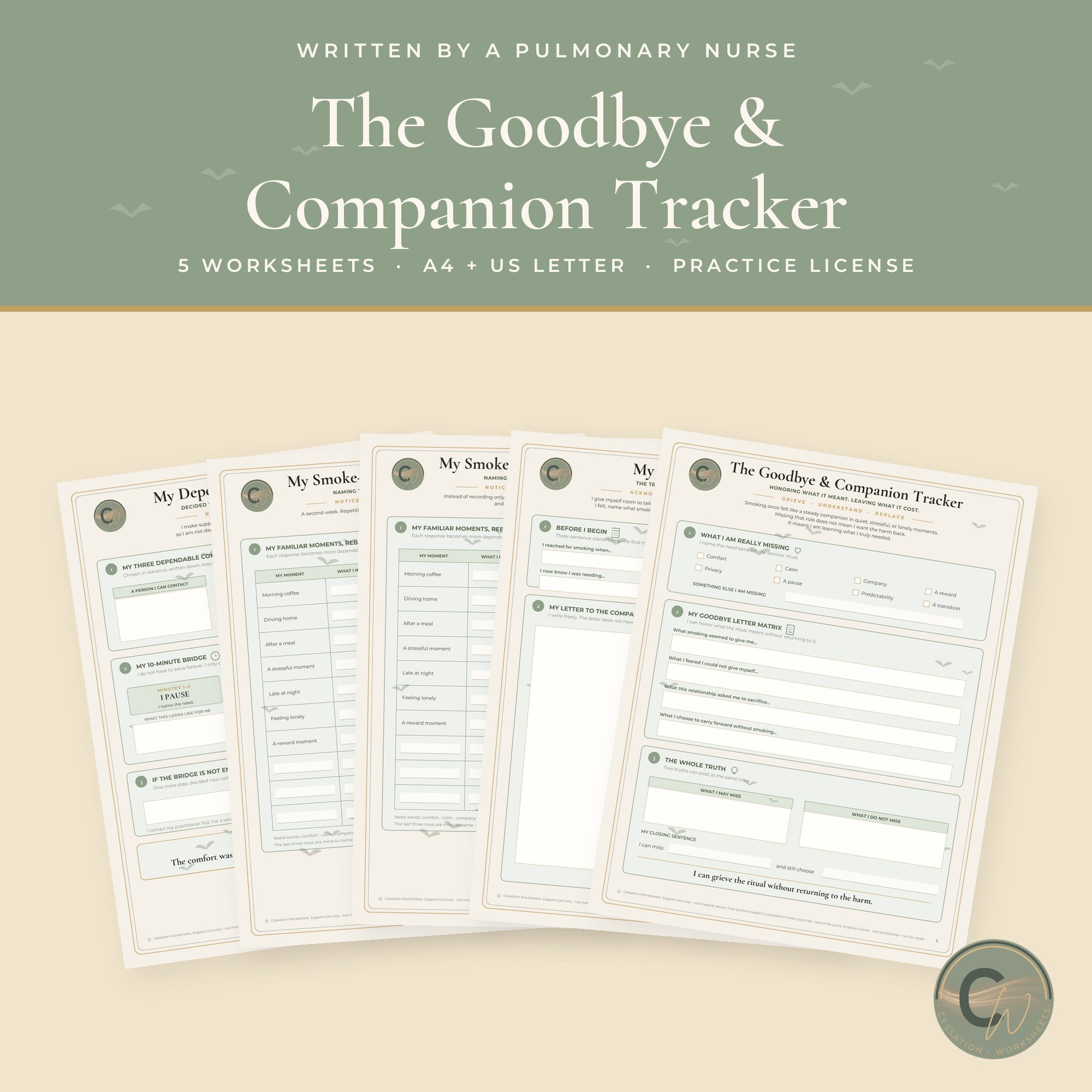
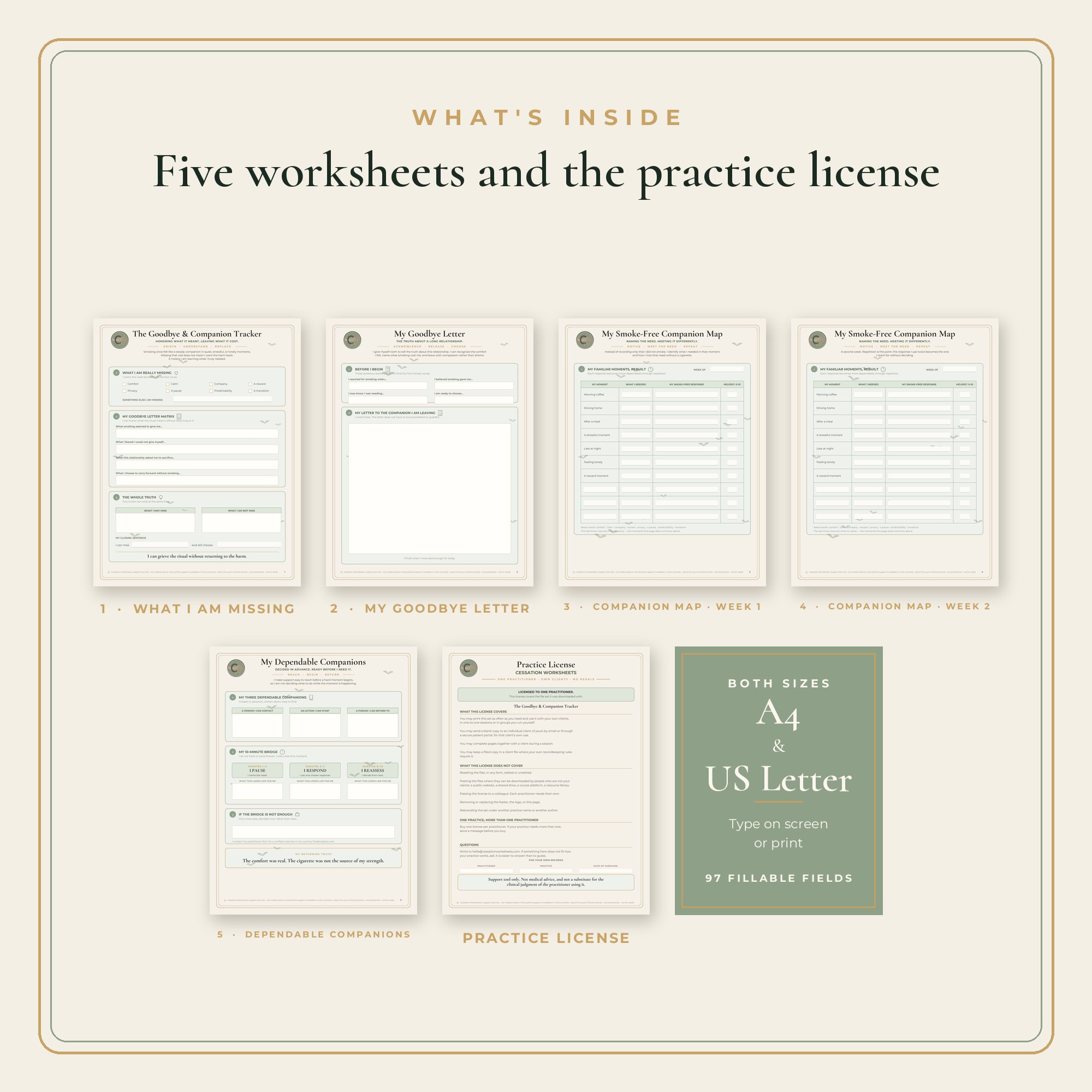
Five pages — US Letter and A4 both included — 97 fillable fields.
Plus the license page, in both sizes.
1 — The Goodbye & Companion Tracker
What the client is actually losing, separated from the harm they are glad to be rid of. Eight needs to check off, a short matrix that sorts what smoking gave and what it cost, two columns for what they may miss and what they do not, and one closing sentence: I can miss ___ and still choose ___.
2 — My Goodbye Letter
A letter to the habit, not about it, with four sentence openers so the client is not facing a blank page. No character limit on the field.
3 — My Smoke-Free Companion Map, week one
Ten rows. Seven moments already printed, three left open for the ones only this client has. What was needed in that moment, what was used instead, and how much it helped from 0 to 10.
4 — My Smoke-Free Companion Map, week two
The same map a week later. The comparison is the exercise.
5 — My Dependable Companions
Three companions chosen in advance — a person to contact, an action to start, a phrase to return to. A ten-minute bridge for the moments they do not cover, and a plan for when the bridge is not enough.
How it sits in a session
Pages 1 and 2 work as a single opening exercise, and the letter can be written between sessions.
Pages 3 and 4 are a two-week homework pair. The client fills the first map, brings it back, and fills the second one a week later. The two maps side by side give you something concrete to open the next appointment with.
Page 5 is the closing page and works as a written plan the client keeps.
The 0 to 10 score on pages 3 and 4 is the part most trackers leave out. Most record whether the day was clean. This one records the moment, the need underneath it, and the response that was used instead — scored — so the responses that actually work become visible rather than assumed.
Nothing on these pages asks the client to disclose more than they choose to. There are no diagnostic items and nothing is scored as a total.
The companion map and the ten-minute bridge are behavioral techniques from cognitive behavioral therapy: naming the need behind a smoking moment, and planning in advance the response that meets it.
Three ways to use it
- Hand a client one page, or all five.
- They type straight into it on a phone or tablet.
- Or print it and use a pen — the letter on page 2 was made to be written by hand if that is what the client prefers.
Two sizes, both fillable
US Letter, 8.5 x 11 in — United States and Canada
A4, 210 x 297 mm — the standard size everywhere else
Both are in the download at no extra cost, and both work the same way: type on screen, or print. The fields do not show on paper.
Before you start
Open the file in Adobe Acrobat Reader — it’s free, on iPhone, Android, Mac and Windows. A browser preview will show the pages, but it won’t reliably keep what a client types.
Keep the blank original blank. Save filled copies under a new name.
The practice license
One practitioner, unlimited clients, worldwide. Print for your own clients, use one-to-one and in groups you run yourself, send a blank copy to an individual client, and keep a filled copy in a client file where your recordkeeping rules require it. Not for resale, and not transferable to a colleague — each practitioner needs their own. The full terms come as a separate page in the download.
Personalized license copy, on request
The license page carries the name of this set and has fields for your name, your practice, and the date of purchase, so you can complete it yourself and keep it with your records. If you would rather have those details typeset into the page instead of typed into a form field, write to hello@cessationworksheets.com after your purchase and I will send one back. No charge — it is part of the license.
How buying works
Checkout runs through Gumroad, a payment platform used by independent creators worldwide. You pay on their secure checkout page, and your card details never reach me.
The price shown here is $7.99 before tax. VAT or sales tax is added at checkout, based on where you live, so the total can differ from country to country. You see the full amount before you pay.
Charges are processed in US dollars. Outside the United States, your bank converts the amount and may add a small fee of its own.
Straight after payment you get a download link on screen and by email, with both files — A4 and US Letter — and a receipt.
Who wrote this
I am a pulmonary nurse, trained in asthma and COPD. I work in a respiratory outpatient clinic, where I see people with asthma and COPD and run the smoking cessation consultations. I am listed in KABIZ, the Dutch quality register for healthcare professionals, which means I work to the national care standard for tobacco and nicotine dependence.
Evidence-informed and developed with reference to current tobacco-dependence and smoking-cessation guidelines, using CBT-informed behavioral tools to support structured cessation conversations.
Every page is built on national standards for tobacco dependence and on published evidence, and checked against the guidance in each. See the seven guidelines.
No lectures. No scare tactics.
Instant digital download. Nothing is shipped. No refunds once the download has been opened. If the file does not work as described, write to me and I will sort it out.
Support tool only — not medical advice, and not a substitute for the clinical judgment of the practitioner using it.