
Description
“Thirty years, on and off. Well — more on than off.” That is how most smoking histories arrive: in one sentence, at the start of an appointment, with everything that matters still inside it.
The client is sitting across from you and you have forty minutes. Twenty of them go to working out when it started, how much it is now, what they have already tried and how many times. By the time you have the picture, the appointment is half gone.
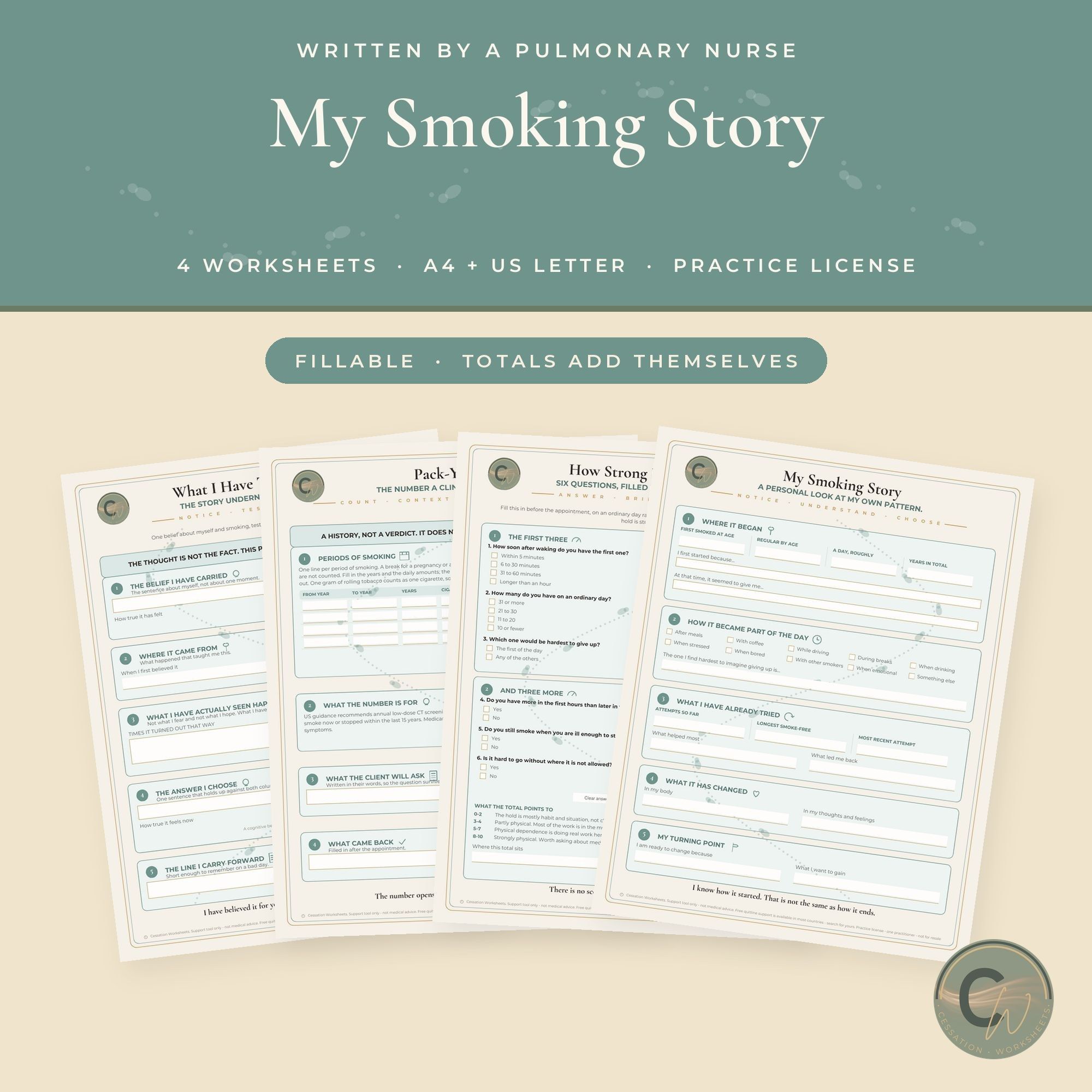
These four pages get filled in before that — and the two of them that carry numbers do their own arithmetic.
For clinicians, coaches and quit advisors
Plenty of worksheets let you print and use them with clients. This one does too. Here is what it adds.
- You may give a client their own blank copy to keep, by email or through a secure patient portal.
- You may use it in groups you run yourself.
- You may print without limit, for as long as you practice.
- And a written license page comes as a separate sheet in the download, so your practice has something to file.
One practitioner. Not transferable to a colleague, and not for resale.
Written for smoking cessation
Not adapted from a general intake form. Every page was built for the first conversation with someone who has smoked for years — by a nurse with twenty-five years in pulmonary care who is also a certified quit coach.
Why the history, and not willpower
A client who has smoked for thirty years already knows what smoking does to them. What they have usually never done is write the story down: when it started, what it attached itself to, what has already been tried and what led back.
The two numbers a clinician needs at the start — how strong the hold is, and how many pack-years — are rarely on paper at the first appointment either. They get estimated in the room, or asked for later. These pages bring both to the table, worked out, before the conversation begins.
What you get
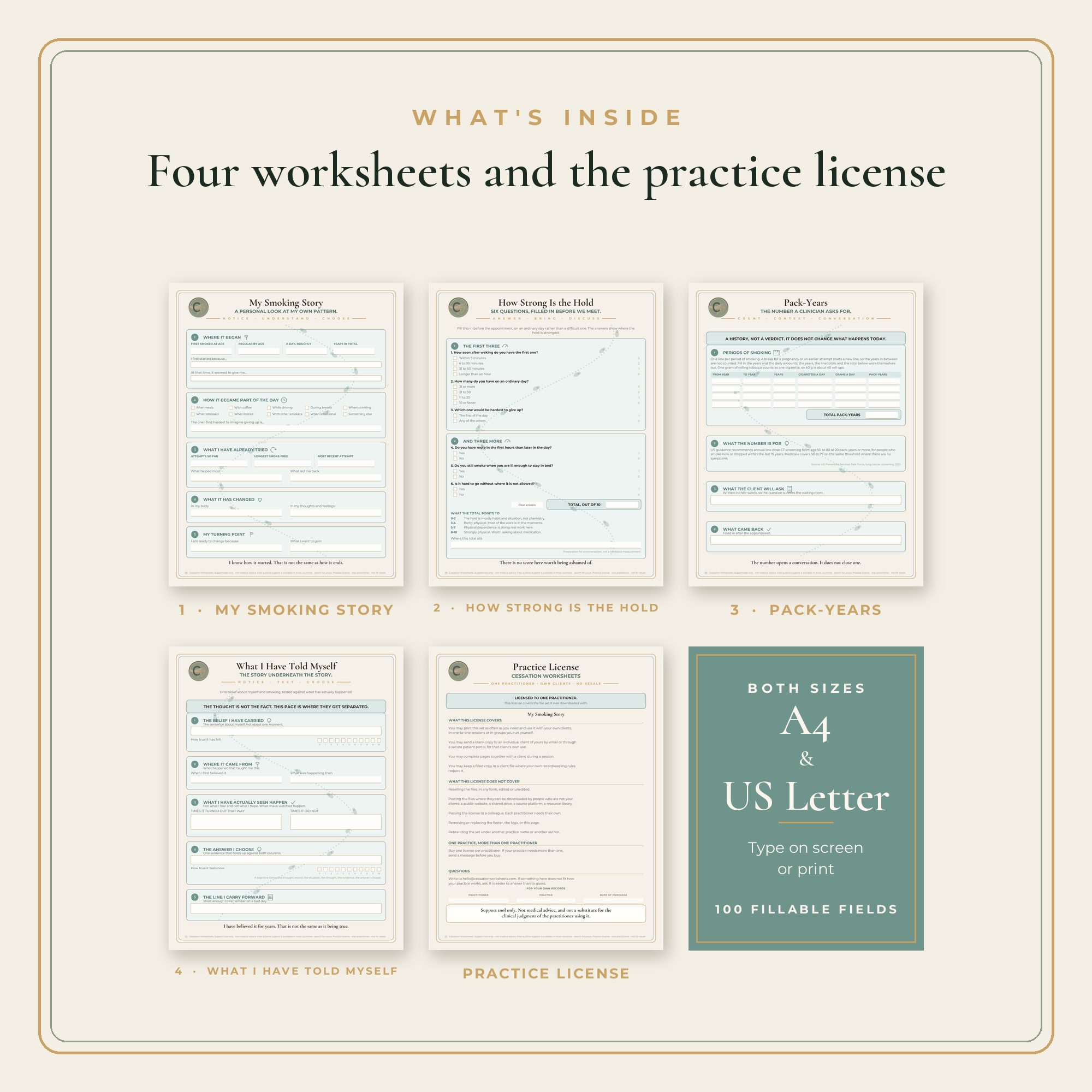
Four pages — US Letter and A4 both included — 100 fillable fields.
Plus the license page, in both sizes.
1 — My Smoking Story
Where it began, at what age and why.
What it became part of, with ten moments to tick and a line for the one hardest to imagine giving up.
What has already been tried, what helped most and what led back. What it has changed, and the turning point — in the client’s own words.
2 — How Strong Is the Hold
Six questions the client answers before the appointment, on an ordinary day rather than a difficult one.
The sheet totals the answers out of ten and names what the total points to, from mostly habit to strongly physical. Preparation for a conversation, not a validated measurement.
3 — Pack-Years
Room for four separate periods of smoking, with the years in between left out. A pregnancy, a stop that held for two years, a restart at a higher amount: each one gets its own line, and the quit periods are not counted as smoking. The years, the line totals and the grand total work themselves out. Rolling tobacco is covered — one gram counts as one cigarette, so forty grams is about forty roll-ups. A line for the question the client will ask their doctor, and one for what came back.
4 — What I Have Told Myself
A cognitive behavioral thought record around one belief about themselves and smoking: where it came from, what they have actually seen happen on both sides, and the answer they choose — rated 0 to 10 before and after. A line short enough to remember on a bad day.
Two totals that do themselves
This is the part a printed worksheet cannot do.
The dependence check adds itself up. The client ticks six answers and the sheet totals them out of ten, then names the band the total falls in — from mostly habit and situation to strongly physical, worth asking about medication.
The pack-years work themselves out. The client fills in the years and the daily amount for each period of smoking; the sheet calculates the years per line, the pack-years per line, and the grand total. Cigarettes and grams of rolling tobacco both count.
Nothing to work out in the room, and no arithmetic to check afterwards.
The number is on the page when the client arrives. This happens on screen, in Adobe Acrobat Reader; on paper the totals are lines to fill in by hand.
How it sits in a session
Pages 1 and 2 are filled in before the first appointment. The client arrives with the history written and the dependence score already totalled, and you open with the pattern instead of the questionnaire.
Page 3 can be done at home or together in the room. The number belongs in the client’s own primary care record, whatever the local screening threshold is; the sheet keeps the question they will ask and the answer they got.
Page 4 is homework between sessions. The two ratings, before and after, give you something concrete to open the next appointment with.
The dependence check is scored, out of ten, and says in plain words what the band points to. It is the only total on these pages, and it is written as the start of a conversation, not a verdict. Nothing asks the client to disclose more than they choose to, and nothing asks for a diagnosis.
Three ways to use it
- Hand a client one page, or all four.
- They type straight into it on a phone or tablet — and the dependence score and the pack-years add themselves up as they go.
- Or print it and use a pen. On paper the totals are lines to fill in by hand.
Two sizes, both fillable
US Letter, 8.5 x 11 in — United States and Canada
A4, 210 x 297 mm — the standard size everywhere else
Both are in the download at no extra cost, and both work the same way: type on screen, or print. The fields do not show on paper.
Before you start
Open the file in Adobe Acrobat Reader — it’s free, on iPhone, Android, Mac and Windows. A browser preview will show the pages, but it won’t reliably keep what a client types, and it will not do the arithmetic.
Keep the blank original blank. Save filled copies under a new name.
The practice license
One practitioner, unlimited clients, worldwide. Print for your own clients, use one-to-one and in groups you run yourself, send a blank copy to an individual client, and keep a filled copy in a client file where your recordkeeping rules require it. Not for resale, and not transferable to a colleague — each practitioner needs their own. The full terms come as a separate page in the download.
Personalized license copy, on request
The license page carries the name of this set and has fields for your name, your practice, and the date of purchase, so you can complete it yourself and keep it with your records. If you would rather have those details typeset into the page instead of typed into a form field, write to hello@cessationworksheets.com after your purchase and I will send one back. No charge — it is part of the license.
How buying works
Checkout runs through Gumroad, a payment platform used by independent creators worldwide. You pay on their secure checkout page, and your card details never reach me.
The price shown here is $7.99 before tax. VAT or sales tax is added at checkout, based on where you live, so the total can differ from country to country. You see the full amount before you pay.
Charges are processed in US dollars. Outside the United States, your bank converts the amount and may add a small fee of its own.
Straight after payment you get a download link on screen and by email, with both files — A4 and US Letter — and a receipt.
Who wrote this
I am a pulmonary nurse, trained in asthma and COPD. I work in a respiratory outpatient clinic, where I see people with asthma and COPD and run the smoking cessation consultations. I am listed in KABIZ, the Dutch quality register for healthcare professionals, which means I work to the national care standard for tobacco and nicotine dependence.
Evidence-informed and developed with reference to current tobacco-dependence and smoking-cessation guidelines, using CBT-informed behavioral tools to support structured cessation conversations.
Every page is built on national standards for tobacco dependence and on published evidence, and checked against the guidance in each. See the seven guidelines.
No lectures. No scare tactics.
Instant digital download. Nothing is shipped. No refunds once the download has been opened. If the file does not work as described, write to me and I will sort it out.
Support tool only — not medical advice, and not a substitute for the clinical judgment of the practitioner using it.